
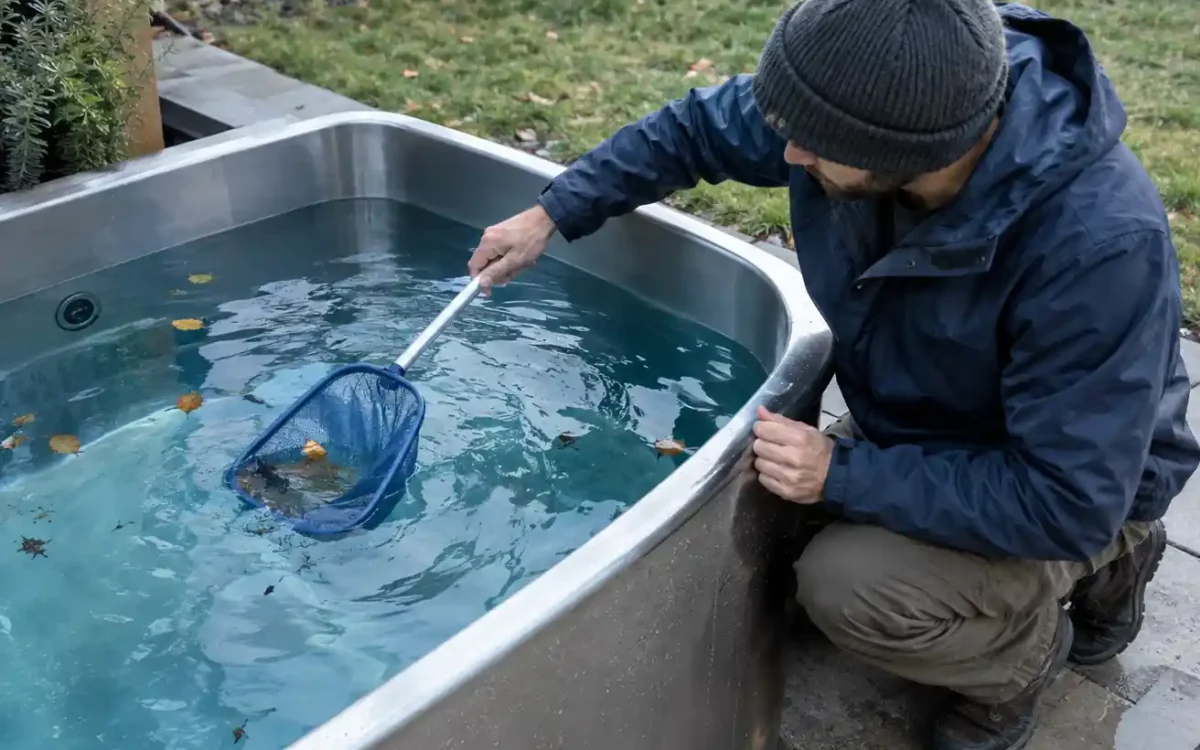
I’ll be honest about how I learned this stuff: the hard way. About a month into owning my first plunge tub, I lifted the cover one morning and was greeted by water that looked… tired. Slightly cloudy, a little slick along the waterline, with a faint smell I didn’t want to think too hard about. I’d been topping it off with fresh water and telling myself the cold would handle the rest.
That belief — that ice-cold water somehow stays clean on its own — is the single most common misunderstanding in cold plunge water treatment. And I held it confidently until my tub proved me wrong. Here’s the truth that changed everything for me: cold water doesn’t sanitize anything. It just slows bacteria down. Once I understood that, keeping my water crystal clear for weeks at a time got dramatically simpler — and cheaper than the endless drain-and-refill cycle I’d been stuck in.
This guide compares the five cold plunge water treatment methods that actually work, with honest notes on cost, effort, and safety. No product pushing, no chemistry degree required — just what I wish someone had told me on day one.
Cold Water Doesn’t Kill Germs: Why Your Tub Gets Dirty So Fast
Let’s kill the myth first, because everything else follows from it. Cold water is not sterile water. The bacteria, body oils, sweat, sunscreen, and dead skin cells you bring into the tub don’t die at 50°F — they just reproduce more slowly than they would in a warm hot tub. Given a few days, they still build up. They form biofilm, that slippery layer on the tub walls, which protects them and turns the water cloudy.
Your cold plunge has the opposite problem of a hot tub. Hot tubs need aggressive sanitation precisely because warmth accelerates microbe growth — everyone knows that. A cold plunge lulls you into complacency instead. The water feels fresh and biting, so you assume it’s clean. Meanwhile, every session deposits organic matter that becomes food for whatever is living in there.
This isn’t just about aesthetics. Poorly maintained plunge water can cause skin irritation, rashes, and ear or eye infections — the same family of problems as a neglected hot tub, just slower to develop. The CDC’s hot tub guidance makes the same point for warm water: without proper disinfectant levels, recreational water becomes a health risk. Cold water buys you time, not immunity.
The good news: because cold slows everything down, a little treatment goes a long way. A simple routine can keep the same water clean for two to four weeks — instead of the two or three days most beginners get before things turn.
The 5 Cold Plunge Water Treatment Methods, Compared
Every cold plunge water treatment approach falls into one of five buckets. Most good setups use two of them together — one to kill microbes, one to remove the particles they leave behind. Here’s the honest breakdown:
| Method | How It Works | Best For | Watch Out For |
|---|---|---|---|
| Mechanical filtration | A cartridge filter physically traps particles, oils, and debris as water circulates | Any tub with a pump or chiller | Removes particles, not microbes — it cleans but doesn’t sanitize; cartridges need regular rinsing |
| UV-C sterilizer | Ultraviolet light damages the DNA of bacteria, viruses, and algae as water passes the lamp | Chiller systems with built-in UV | Only treats water flowing past the lamp; leaves no residual protection in the tub itself |
| Ozone generator | Injects ozone (O³), a powerful oxidizer that destroys contaminants on contact | Chiller systems with built-in ozone | Dissipates within minutes; must be properly injected, and it can degrade cheap rubber seals over time |
| Hydrogen peroxide | A simple oxidizer that breaks down into water and oxygen, leaving no harsh residue | Simple ice-only tubs without pumps | Must be dosed carefully with test strips; degrades in sunlight; buy plain, unscented 3% only |
| Chlorine or bromine | Classic sanitizers that kill microbes and keep protecting the water for days | Larger tubs and heavy-use setups | Easy to overdo — irritates skin and eyes at high levels and can damage chiller components |
Notice the pattern: filtration removes the dead stuff, while UV, ozone, peroxide, and chlorine handle the living stuff. That’s why the strongest setups pair one from each column — a filter plus one sanitizer. A sanitizer with no filtration leaves debris floating around; filtration with no sanitizer just circulates live microbes more efficiently. The EPA’s UV treatment toolkit is a good deep read on how UV disinfection actually works if you want the technical background.
Ozone vs UV vs Hydrogen Peroxide: Which Should You Actually Pick?
This is the decision most people get stuck on, so let me simplify it by setup type — because the “best” cold plunge water treatment depends entirely on what kind of tub you own.
If you own a chiller with built-in sanitation, use what’s built in. Many modern chillers ship with an ozone generator, a UV sterilizer, or both — check our best cold plunge chiller guide if you’re still shopping. These systems are designed to work together with the unit’s filter, and adding extra chemicals on top usually causes more problems than it solves.
If you run a simple ice-only tub with no pump, hydrogen peroxide is the most practical option. There’s nothing to install and no electricity involved — you add a small measured dose and stir it through the water. Pair it with a skimmer net and a tight-fitting cover, and you’re covering both jobs: killing microbes and keeping debris out.
If you want the lowest-effort routine and don’t mind the upfront cost, a chiller with ozone plus a cartridge filter is the closest thing to set-and-forget. The ozone sanitizes continuously, the filter catches particles, and you mostly just rinse the cartridge once a week.
What I’d avoid: buying a standalone ozone or UV unit for a tub with no circulation. Both technologies only treat water that flows past them — in a still tub, they’re expensive decorations.
What About Just Changing the Water?
Fair question — sometimes the simplest cold plunge water treatment is no treatment at all. If your tub holds 80 gallons and your tap water is cheap, draining and refilling every few days might cost less than sanitizers and filters. Our breakdown of what a cold plunge really costs includes the water math if you want to run your own numbers.
But do the honest math first. Draining, scrubbing, and refilling a 100-gallon tub is a 30–45 minute chore, plus the water itself and the time (or ice) needed to get it cold again. Do that twice a week and you’re spending hours a month on maintenance. A basic treatment routine — rinse the filter, add a measured dose of sanitizer, keep the cover on — takes about ten minutes a week and stretches the same water to a month.
My rule of thumb: if your tub is small (under 60 gallons) and you plunge solo, frequent water changes are perfectly reasonable. If it’s a full-size tub or multiple people use it, treatment pays for itself in time alone.
6 Cold Plunge Water Treatment Mistakes to Avoid
Most water problems I hear about trace back to one of these. Run through the list before you buy anything:
Assuming cold means clean. Cold slows bacteria; it doesn’t kill them. Treat every tub like it needs sanitation, because it does.
Mixing chemicals. Never combine chlorine with hydrogen peroxide or other sanitizers unless a product specifically instructs it. Mixed chemicals can release harmful gases or cancel each other out.
The “more is better” overdose. Doubling the sanitizer doesn’t double the cleanliness. It irritates skin and eyes, bleaches swimwear, and can corrode chiller seals and fittings.
Ignoring the filter cartridge. A clogged filter is a bacteria hotel. Rinse it weekly and replace it when the pleats stay discolored after rinsing. Our cold plunge maintenance guide has the full routine.
Using the wrong peroxide. Only use plain, unscented 3% hydrogen peroxide. Concentrated “food grade” 35% is caustic at full strength and must be diluted precisely — not worth the risk for most people.
Skipping the cover. Sunlight degrades peroxide and sanitizers fast, and every leaf, insect, and dust mote that lands in the water becomes microbe food. A cover is the cheapest water treatment you can buy.
What I actually do. For context — not a prescription, just what works for me. I run a chiller tub with a cartridge filter and built-in ozone. Once a week I pull the filter, hose it down, and wipe the waterline with a clean cloth. I keep the cover on whenever I’m not plunging. About once a month, I drain, do a quick scrub, and refill. Total effort: maybe 15 minutes a week. The water stays clear, there’s no smell, and I’ve never had skin irritation.
Before the chiller, I ran an ice-only tub with the same routine minus the ozone, plus a small weekly dose of 3% hydrogen peroxide measured with test strips. Both worked — the chiller setup just asks less of me.
Frequently Asked Questions
With a basic cold plunge water treatment routine — filtration plus a sanitizer — most home tubs can go two to four weeks between full water changes. Without any treatment, plan on every two to four days, sooner if multiple people use the tub or the water looks or smells off. Clear, odor-free water with no slick feeling on the walls is your green light to keep going.
Yes, in low, carefully measured doses. The CDC recommends at least 3 ppm chlorine or 4–8 ppm bromine for hot tubs, with pH between 7.0 and 7.8 — cold plunge targets are similar or slightly lower, since cold slows microbe growth. The catch: chlorine can degrade rubber seals and irritate skin if overdosed, and some chiller manufacturers advise against it. If your chiller manual says no chlorine, respect that.
A common starting point is about one cup of plain 3% hydrogen peroxide per 100 gallons of water, added weekly — but treat that as a starting point, not gospel. Tub size, bather load, and sunlight exposure all change the math. Use peroxide test strips to stay in a sensible range, dose in the evening (sunlight breaks peroxide down fast), and never use scented or “color-safe” varieties.
Yes, when it’s properly injected into the plumbing of a chiller system — that’s how most built-in ozone units work, and the ozone dissipates within minutes of doing its job. What you should not do is breathe concentrated ozone directly or run an unvented ozone generator in a small enclosed space. Built-in units from reputable chiller brands handle injection and venting correctly by design.
Yes — they do different jobs. Peroxide kills microbes but leaves their remains, plus all the physical debris (skin cells, hair, dust), floating in the water. A filter physically removes that material. Sanitizer without filtration is like sweeping without a dustpan: half the job.
No. Cold water slows bacterial growth significantly — which is why plunge water stays fresher longer than hot tub water — but it doesn’t sterilize anything. Some bacteria simply go dormant in the cold and resume growing when conditions improve. That’s the entire reason cold plunge water treatment exists: the cold buys you time, and treatment does the actual sanitizing.
So here’s the question I’d leave you with: is your current routine actually keeping the water clean, or just keeping it cold? For my first month, I couldn’t have answered honestly — the water felt pure because it was biting, and I mistook sensation for sanitation.
You don’t need a chemistry set or an expensive system. Pick one sanitizer that fits your setup, pair it with filtration (or at least a cover and a skimmer), and give it a month. The test is simple: clear water, no smell, no slick walls. If you’ve got all three, your cold plunge water treatment is working — and you’ll never go back to the drain-and-refill hamster wheel.

Related Articles
Best Portable Cold Plunge: What to Look for Before You Buy
A quick note before you read on: This guide covers what to look for and general expectations when…
Read Guide
Cold Plunge Maintenance Tips: How to Keep Your Tub Clean and Safe
A quick note before you read on: This article is for general educational purposes and reflects common maintenance…
Read Guide
Inflatable Cold Plunge Tub: Is It Actually Worth Buying?
This article is for general informational purposes only. Product durability and performance can vary by manufacturer and how…
Read Guide