
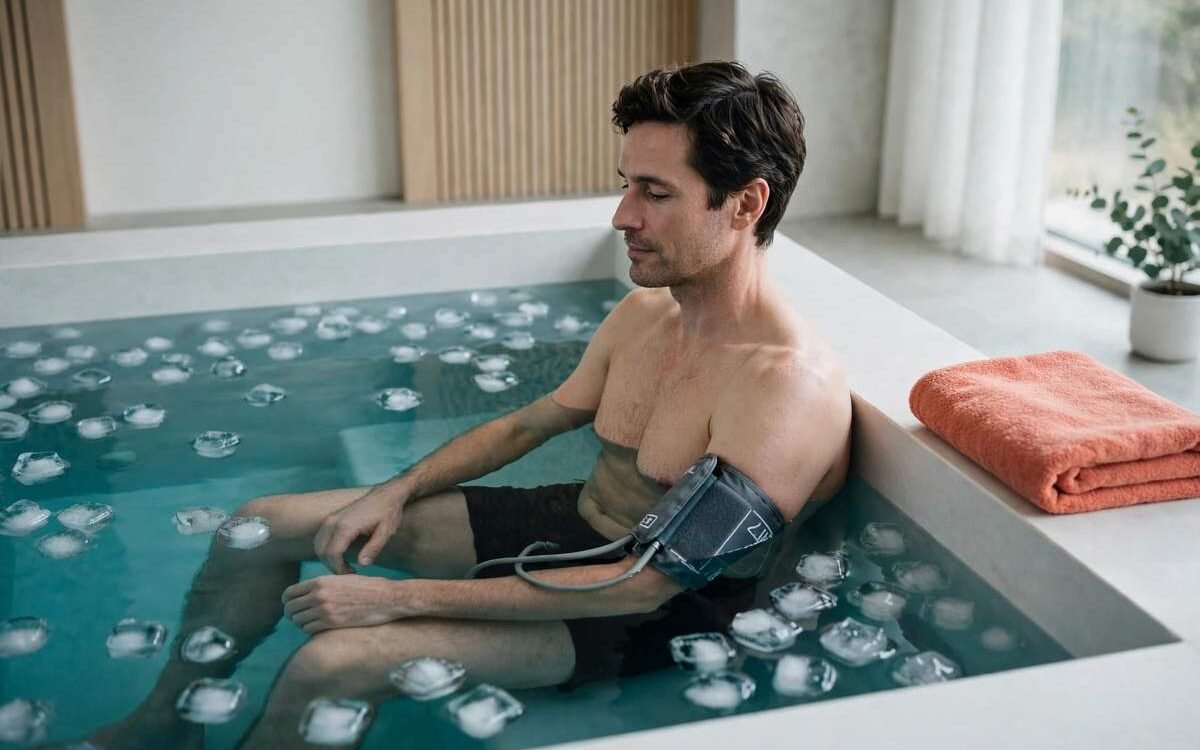
Safety · Heart Health
Cold Plunge and High Blood Pressure: Is It Safe?
Cold water feels powerful — but if your blood pressure runs high, that first gasp matters more than the hype. Here is the honest, doctor-first answer.
Cold water raises blood pressure first — that is the part to respect before you step in.
The short answer
Cold plunge and high blood pressure are a cautious combination, not a casual one. Cold water makes your blood vessels narrow, and that pushes your blood pressure up for a short time. If your blood pressure is high, uncontrolled, or you have a heart condition, talk to your doctor first — and do not get into a cold plunge until your doctor says it is OK. If your blood pressure is well controlled, you take your medicine as prescribed, and your doctor clears you, a careful, short plunge may be an option for some people. A cold plunge is never a treatment for high blood pressure, and it is never a reason to stop your medicine.
Cold plunging is everywhere right now — tubs in backyards, ice baths in gyms, and videos of people gasping their way into freezing water. The benefits get a lot of attention. The blood pressure question gets much less. That is a problem, because for people with high blood pressure, the first minute in cold water is the part that matters most.
High blood pressure is common, and many people live with it without feeling any symptoms at all. That quiet part is what makes it tricky. You can feel perfectly fine and still have numbers that put extra strain on your heart and blood vessels. Cold water adds a sudden, sharp load on top of that — and unlike a workout, where the effort builds up slowly, a plunge hits your system all at once.
This guide explains, in plain language, what cold water does to blood pressure, who should be careful, who should skip plunging altogether, and — if your doctor gives you the green light — how to try it in the safest possible way. Nothing here replaces your doctor. Think of it as the conversation to have before you have the conversation with your doctor.
Why Cold Water Raises Your Blood Pressure
To understand the risk, it helps to know what actually happens in the first minute of a cold plunge. Your body treats sudden cold as an emergency, and it reacts fast — before you have time to think about it.
1Cold hits your skinYour skin sensors fire an alarm the moment you step in.
2Vessels narrowBlood vessels near the surface tighten to keep your core warm.
3Heart works harderYour heart rate jumps as your nervous system switches to alert mode.
4Pressure risesBlood pressure climbs quickly, then settles as you warm up.
The key player here is vasoconstriction — the narrowing of your blood vessels. When vessels narrow, the same amount of blood has to move through a tighter space, so the pressure inside goes up. At the same time, the cold shock response kicks in: you gasp, your breathing speeds up, and your sympathetic nervous system — the same system that drives the fight-or-flight response — floods your body with stress signals. Your heart beats faster and harder. For a healthy heart, this is a short, sharp stress that usually passes as you warm up. For a heart that is already working against high blood pressure, it is extra load at exactly the wrong moment.
That rise is temporary. As you get out and warm up, your vessels relax and your blood pressure usually drifts back toward where it started. But “temporary” does not mean “harmless.” The risk with high blood pressure is not the average of your day — it is the peak. A sudden spike on top of already-high numbers is what doctors worry about, because that is when the strain on the heart and blood vessels is at its highest. That is why cold plunge and high blood pressure is a combination doctors take seriously, even for people who feel completely fine.
“Cold water does not gently lower blood pressure — it pushes it up first, and that is exactly why caution comes first for anyone whose numbers already run high.”
Water temperature matters too. A cool plunge in the high 50s Fahrenheit feels very different from an ice-cold plunge in the 30s or 40s. Colder water triggers a stronger cold shock response, which means a bigger and faster rise in blood pressure. That is one reason a gradual approach — starting cool rather than ice-cold — is part of every safer way to try cold plunging. If you want a deeper look at how to think about water temperature in general, our guide to whether cold plunging is safe covers the wider safety picture.
Know Your Numbers First
Before you think about a cold plunge, you need to know where your blood pressure actually sits. “High blood pressure” is not one thing — it is a range, and where you sit in that range changes the answer. Knowing your numbers is the first step in deciding whether cold plunge and high blood pressure can mix safely for you. The American Heart Association groups adult readings into five categories. Here they are, with what each one means for cold plunging.
| Category | Top number (systolic) | Bottom number (diastolic) | What it means for a cold plunge |
|---|---|---|---|
| Normal Usual range | Less than 120 | Less than 80 | Generally the lowest-risk group — still check with your doctor if you have other heart risks. |
| Elevated Watch it | 120–129 | Less than 80 | Caution. Talk to your doctor before your first plunge and keep sessions short. |
| Stage 1 High | 130–139 | 80–89 | Doctor first. Do not plunge until your doctor has cleared you in person. |
| Stage 2 Higher | 140 or higher | 90 or higher | Doctor first. Most doctors will ask you to wait or to skip plunging. |
| Crisis Get care | Higher than 180 | Higher than 120 | Do not plunge. A reading this high needs medical care, not cold water. |
Two details matter here. First, the higher of your two numbers sets your category — if your top number is in one band and your bottom number is in a higher one, you belong in the higher band. Second, only a doctor can diagnose high blood pressure. A single high reading at home does not make you hypertensive — readings move around with stress, caffeine, a bad night’s sleep, or even a rushed morning. What matters is the pattern over time, measured properly. If you want to check the categories against the source, the American Heart Association’s page on understanding blood pressure readings lists the full chart.
If you do not know your numbers at all, that is your first step — not the plunge. A quick check at your doctor’s office or a pharmacy gives you the information every other decision depends on. Guessing is not a plan when your heart is involved.
Who Should Be Extra Careful — and Who Should Skip It
Cold plunge and high blood pressure is not a yes-or-no question for everyone. It depends on your whole health picture. Some people should be extra careful. Some should skip cold plunging altogether — at least until a doctor says otherwise.
Skip it for now if you have…
Uncontrolled high blood pressure, a recent heart attack or stroke, heart failure, a known heart rhythm problem, or chest pain that has not been checked out. If any of these apply to you, cold plunging is not a “try it and see” experiment — it is a conversation with your doctor first, full stop.
Be extra careful if you have…
Well-controlled high blood pressure, blood pressure medicine you take daily, diabetes, circulation problems, or you are an older adult. These do not automatically rule plunging out — but they do mean your doctor needs to weigh in before you get in the water.
A few of these deserve a closer look, because they are easy to misunderstand.
Taking blood pressure medicine does not make plunging automatically safe. Medicine helps keep your day-to-day numbers down, but it does not switch off the cold shock response. Your vessels will still narrow and your heart rate will still jump when you hit cold water. Some medicines can also change how your body handles cold or how quickly you warm up afterwards. Never skip a dose to “make room” for a plunge, and never change your medicine schedule without your doctor’s say-so. If your medicine is new, or your dose changed recently, that is another reason to wait and ask first.
Older adults need extra caution. Blood vessels get stiffer with age, and the heart’s ability to cope with sudden stress can be lower — even in people who feel fit. If you are an older adult with high blood pressure, read our guide to cold plunging for seniors as well, and take its safety rules seriously. Shorter, warmer, and supervised beats longer, colder, and alone — every time.
Diabetes and circulation problems add another layer. Diabetes can affect blood vessels and nerves, including how well you feel cold or notice warning signs in your body. Poor circulation means your body may warm up more slowly after a plunge. If this is you, our article on cold plunge and diabetes walks through the same doctor-first approach for that condition, and the same logic applies here: check first, plunge later — if at all.
Pregnancy is a different picture entirely. Blood pressure goals during pregnancy are different, and cold water immersion has its own set of risks. If you are pregnant and have high blood pressure, do not cold plunge without your obstetrician’s clear approval.
And one more: if you feel unwell on the day, skip it. A cold, the flu, a fever, or just feeling run down is not the day to add a cold shock to your system. Our guide on cold plunging when sick explains why rest beats a plunge when your body is already fighting something.
Can a Cold Plunge Lower Blood Pressure Over Time?
This is the question that keeps the idea alive for a lot of people — and it deserves an honest answer: there is no good evidence that cold plunging lowers blood pressure over time or treats hypertension. That is the truth as it stands today, and any article that tells you otherwise is selling you something. The idea that cold plunge and high blood pressure might somehow cancel each other out is appealing, but it is not how the body works.
Here is where the confusion comes from. Some people step out of a cold plunge feeling calm, clear-headed, and relaxed. That feeling is real. But feeling relaxed for an hour is not the same thing as having lower blood pressure for weeks or months. The relaxation comes from the warm-up afterwards — your vessels open back up, your breathing slows, and the stress hormones of the cold shock fade. None of that has been shown to bring high blood pressure down in a lasting way.
What has been shown to help blood pressure over time is far less exciting, and far more reliable: regular movement, a healthy weight, less salt, less alcohol, enough sleep, and taking prescribed medicine as directed. Those are the tools your doctor will talk about, because those are the tools with real evidence behind them. If you want the fuller picture of what cold plunging may help with — and what it cannot do — our guide to cold plunge benefits keeps the same honest line: real benefits where they exist, no miracles where they do not.
So if your goal is lower blood pressure, a cold plunge is the wrong tool for the job. And if your blood pressure is already high, chasing an unproven benefit while taking on a real risk is a bad trade. Sort the blood pressure out with your doctor first. The tub will still be there later.
The Safer Way to Try It (Only If Your Doctor Says Yes)
If your doctor has cleared you — in person, knowing your numbers and your history — then a careful approach can keep the risk as low as possible. This is not a “safe” recipe. It is a safer one. Every step below matters, and skipping one undoes the others. This is the part of the cold plunge and high blood pressure conversation that only applies after your doctor says yes.
- Get your doctor’s OK first — and mean it. Not a quick “probably fine” in passing, but a real conversation where your doctor knows your readings, your medicine, and your heart history. If your doctor says no, that is the answer.
- Check your blood pressure that day. If it is higher than your usual, skip the plunge. A bad-numbers day is not a plunge day, no matter how good you feel.
- Start with cool water, not ice-cold water. Begin in the high 50s Fahrenheit rather than the 30s or 40s. You can always go colder later — you cannot undo a shock you have already taken.
- Keep it very short at first. Thirty to sixty seconds is enough for a first session. Build up slowly over weeks, a few seconds at a time, if your doctor is happy with how you are doing.
- Never plunge alone. Have someone nearby who knows you have high blood pressure and knows what to do if something goes wrong. This rule has no exceptions.
- Keep your head out of the water. Dunking your head triggers a stronger diving response on top of the cold shock — extra strain you do not need.
- Get out slowly and warm up gently. Dry off, layer up, move around lightly, and drink something warm. Do not jump into a hot shower right away. Our guide to what to do after a cold plunge walks through the rewarming steps in order.
- Mind the timing. Do not plunge right after a heavy meal or after drinking alcohol — both add strain of their own. Our article on cold plunging after eating explains how long to wait. And if you are new to all of this, start with our guide on how to start cold plunging before you add blood pressure into the mix.
One more thing that sounds small and is not: keep a simple log. Note the date, the water temperature, how long you stayed in, and how you felt afterwards. If your doctor asks how it went, “I felt fine” is a guess — a log is an answer. And if anything felt off, even slightly, that log is what helps your doctor decide whether you should keep going.
Warning Signs: Get Out and Get Help
Most warning signs are your body telling you the load is too much. Do not try to push through any of them. The cold will still be there tomorrow — your health might not be, if you ignore what your body is saying.
Get out of the water right away and get medical help if you notice any of these:
- Chest pain, pressure, or tightness
- Trouble breathing or feeling like you cannot catch your breath
- Feeling faint, dizzy, or unusually confused
- A heartbeat that feels irregular, racing, or strangely slow
- A sudden, severe headache
- Numbness, weakness, or trouble speaking
- Lips or skin turning blue, or uncontrollable shivering that does not stop after warming up
Do not get back in. Warm up, sit down, and call for help — emergency services if the symptoms are severe or do not pass quickly. Tell whoever helps you that you were in a cold plunge and that you have high blood pressure.
Frequently Asked Questions
Is it safe to cold plunge if I have high blood pressure?
It depends on your numbers and your health — there is no one-size answer. Cold plunge and high blood pressure are a cautious combination because cold water raises blood pressure for a short time. If your blood pressure is high or uncontrolled, or you have a heart condition, do not plunge until your doctor says it is OK. If your blood pressure is well controlled and your doctor clears you, a careful, short plunge may be an option for some people.
Does cold water raise blood pressure?
Yes — temporarily. When you step into cold water, the blood vessels near your skin narrow to protect your core temperature, your heart rate rises, and your blood pressure climbs. This is the cold shock response, and it is strongest in the first minute. As you get out and warm up, your vessels relax and your blood pressure usually settles back toward where it started.
Can a cold plunge lower my blood pressure?
There is no good evidence that cold plunging lowers blood pressure over time or treats hypertension. Feeling calm after a plunge is real, but it is not the same as a lasting drop in your numbers. The proven ways to bring blood pressure down are regular movement, a healthy weight, less salt, less alcohol, enough sleep, and medicine as prescribed. Never stop blood pressure medicine to try a cold plunge.
I take blood pressure medicine — can I cold plunge?
Medicine does not make plunging automatically safe. It helps control your day-to-day numbers, but it does not switch off the cold shock response — your vessels will still narrow and your heart rate will still jump in cold water. Ask the doctor who prescribed your medicine before you plunge, and never skip a dose or change your schedule to make room for a cold plunge.
What water temperature is safest if I have high blood pressure?
There is no water temperature that has been proven safe for people with high blood pressure. If your doctor clears you, the safer way is to start with cool water — in the high 50s Fahrenheit — rather than ice-cold water, keep sessions to 30–60 seconds at first, and build up slowly over weeks. Colder water means a stronger cold shock response, so colder is not better when your blood pressure is the concern.
What should I do if I feel dizzy or get chest pain in a cold plunge?
Get out of the water right away. Do not try to finish the session or push through it. Dry off, sit down somewhere warm, and get medical help — call emergency services if the chest pain, dizziness, or trouble breathing is severe or does not pass quickly. Tell whoever helps you that you were in a cold plunge and that you have high blood pressure, and do not get back in the water that day.
The bottom line: cold plunge and high blood pressure can mix only with your doctor’s clear approval, short and careful sessions, and a healthy respect for what cold water does to your body. If your numbers are high or uncontrolled, the bravest thing you can do is wait — sort the blood pressure out first, and let the tub wait its turn.

Related Articles
Cold Plunge and Diabetes: Is It Safe?
Cold water and diabetes need extra care. This guide explains the blood sugar risks, what the research really…
Read Guide
Cold Plunge After Eating: Is It Safe? (And How Long Should You Wait)
Medical disclaimer: This article is for general information only and is not medical advice. Talk to a qualified…
Read Guide
Should You Dunk Your Head in a Cold Plunge? 7 Facts About Benefits and Risks
Dunking your head in a cold plunge is optional — and riskier than it looks. Here are 7…
Read Guide