
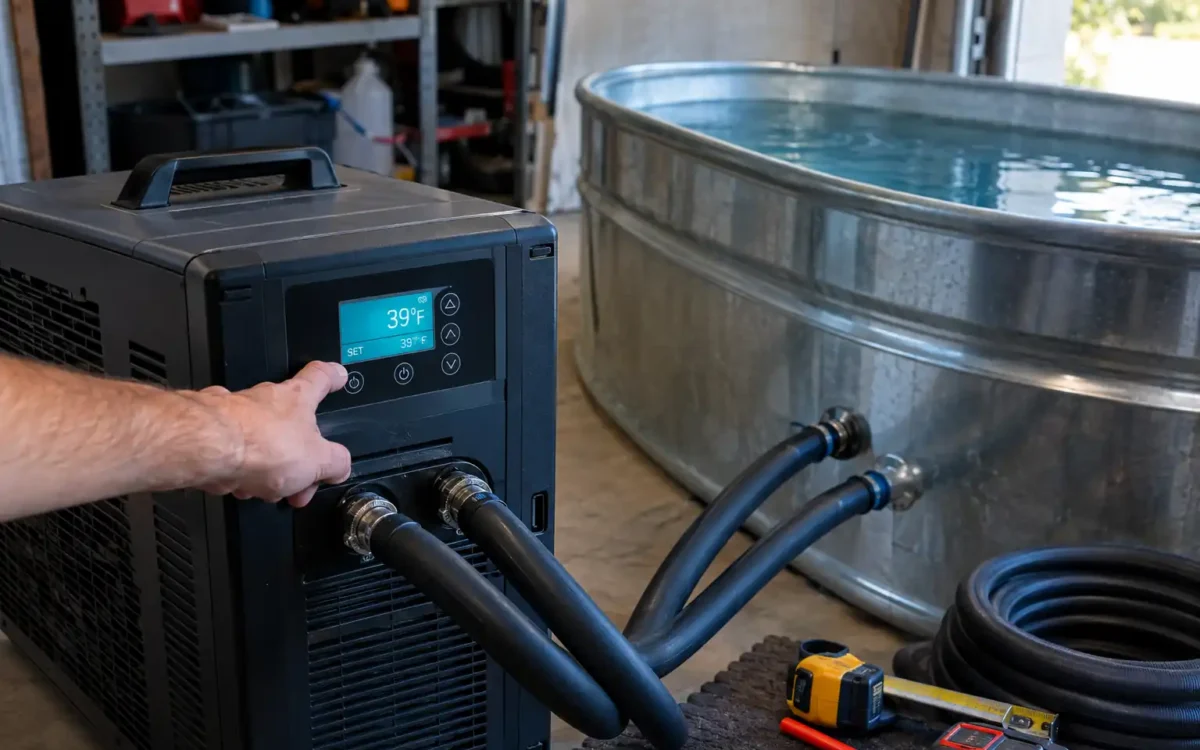
Somewhere around the third grocery run for ice bags in one week, most people start seriously looking into a chiller. Finding the best cold plunge chiller for your situation isn’t about chasing the most powerful unit on the shelf — it’s about matching a few specific numbers to your actual tank, climate, and habits, and skipping the rest of the noise.
Product pages in this space tend to lead with impressive-sounding specs — horsepower, app connectivity, sleek displays — while burying the handful of details that actually determine whether a unit will work for your specific tub. This guide flips that order, starting with the boring numbers that matter most and leaving the extras for last.
Start With HP Sizing, Not the Marketing Claims
How to choose a cold plunge chiller comes down to one core question first: how much water are you actually cooling, and how cold do you want it? Everything else follows from those two numbers, and skipping straight to comparing brands before answering them usually just wastes time.
Cold plunge chiller HP sizing works roughly like this — smaller tanks and milder targets need less horsepower, while bigger tanks or aggressively cold targets need more. Ambient temperature and insulation quality shift these numbers too, since a poorly insulated tank in a hot garage makes any chiller work harder than the same tank in a cool basement.
It’s worth resisting the instinct to just buy the biggest unit available “to be safe.” An oversized chiller for a small, well-insulated tank often cycles on and off more than necessary, which adds wear over time without actually improving your experience. Matching the unit to your actual setup, rather than assuming bigger always means better, tends to produce a more reliable result and a lower electricity bill over the years you’ll actually own it.
| Tank Size | Target Temperature | Typical Chiller Size |
|---|---|---|
| 100–150 gallons | 50°F or milder | 1/4 HP |
| 150–200 gallons | 42–48°F | 1/3–1/2 HP |
| 250+ gallons or aggressive cold | 38–42°F | 1 HP |
These are reasonable starting points, not rigid rules — a warmer climate or a poorly insulated setup might push you toward the next size up even if your tank falls in a lower bracket.
Usage pattern matters here too, beyond just tank size and target temperature. A tub that’s cooled once and then left alone for a day has very different demands than one used by multiple people back to back, where the chiller needs to recover quickly between sessions rather than simply maintain a steady baseline. If your household plans on frequent, overlapping use, sizing up slightly from the chart above is usually the safer call.
Cooling Rate: The Number Marketing Pages Bury
Cold plunge chiller cooling rate explained simply: it’s how many degrees per hour a unit can actually pull out of your water, and it matters more than horsepower alone. Entry-level units often manage somewhere around 5 to 12 degrees per hour, while stronger, better-designed systems can reach 20 to 30 degrees per hour.
This number determines how long you’ll wait between sessions if the water warms up, and how quickly the unit recovers after someone uses it. A chiller with the right horsepower but a poor cooling rate can still leave you waiting far longer than expected before your next plunge.
Manufacturer specs for cooling rate are usually measured under ideal lab conditions, which rarely match a garage in summer or an outdoor deck in direct sun. Treating the advertised number as a best-case ceiling, rather than a guaranteed real-world result, sets more realistic expectations before you’ve spent any money.
Features to Look For Beyond Raw Power
Cold plunge chiller features to look for extend well past temperature control. A few specific additions genuinely change day-to-day usability, even if they don’t show up prominently in a spec sheet’s headline numbers.
It’s easy to fixate on the single lowest-temperature number a unit advertises, but day-to-day satisfaction usually comes down to these smaller, less flashy details instead — the parts that determine whether using the tub feels effortless or like a small chore every single time.
Sanitation
Built-in ozone or UV filtration keeps water usable longer between full changes.
Noise Level
Insulated compressors and quieter fans matter a lot for indoor, daily-use setups.
Controls
Simple digital temperature controls beat manual dials for consistency.
Run-Time Efficiency
Well-insulated setups often only need the chiller running 1–2 hours a day.
Quiet cold plunge chiller options tend to cost a bit more upfront, but for anyone placing a unit near a living space or using it early in the morning, the noise difference is often worth paying for.
It’s also worth asking specifically about warranty coverage on the compressor, since that’s the component most likely to need attention over the unit’s lifespan. A shorter overall warranty with strong compressor-specific coverage is often more meaningful than a longer warranty that only covers the housing and basic electronics.
Chiller vs. Ice: When Each Actually Makes Sense
Chiller vs ice for cold plunge isn’t really a question of which is objectively better — it’s a question of frequency. Occasional use rarely justifies the upfront cost of a chiller, while daily or near-daily plunging usually makes the math work in the chiller’s favor within a matter of months.
Climate plays into this decision more than people expect too. Someone in a naturally cool region might get by comfortably with ice for far longer than someone in a hot, humid climate, where a chiller has to work harder just to counteract ambient heat gain even between sessions. Location alone can shift where that frequency break-even point actually lands.
If you’re building your own setup rather than buying a complete unit, our guide on DIY cold plunge setup walks through exactly how a chiller integrates into a stock-tank build, including the plumbing and pump considerations that come with it.
There’s also a middle path worth mentioning: some people start with ice while testing whether they’ll actually stick with cold plunging, then add a chiller once the habit is confirmed rather than committing to the larger purchase upfront. This staged approach avoids spending on equipment for a routine that might not last, while still leaving the door open to upgrade later without starting over, as long as the tub itself was chosen with chiller compatibility already in mind.
Cost and Long-Term Value
Chiller prices vary enormously depending on horsepower, brand positioning, and included features, and it’s easy to either overspend on capacity you don’t need or underspend and end up frustrated with slow recovery times. For the full financial picture across every setup type, our cold plunge cost breakdown lays out real numbers so a chiller purchase fits into your overall budget rather than being decided in isolation.
If you’re still deciding on the tub itself before even thinking about a chiller, our cold plunge tub buying guide covers how chiller compatibility should factor into that earlier decision, since not every tub accepts every chiller type without extra adapters.
Electricity cost is the ongoing expense people most often underestimate. A well-matched, efficient chiller running only an hour or two a day typically adds a modest amount to a monthly power bill, but an undersized unit running nearly continuously to fight a losing battle against heat and poor insulation can cost noticeably more over a year without ever quite holding the target temperature it was supposed to in the first place.
What My Neighbor’s Upgrade Actually Looked Like
A neighbor of mine hauled ice for his stock tank for almost a full winter before finally buying a chiller, mostly out of sheer exhaustion with the routine. What surprised him most wasn’t the temperature control itself — it was how much more consistently he actually used the tub once the daily ice errand disappeared. The equipment upgrade ended up mattering less for the water quality than for simply removing one more excuse to skip a session.
He also mentioned something I hadn’t considered beforehand: the sound of the compressor cycling on became a strangely reliable cue for him, almost like a kettle boiling. Within a couple of weeks it stopped registering as noise at all and just became part of the background rhythm of his routine, which he said mattered more to how sustainable the habit felt than any of the actual temperature numbers on the unit’s display.
Frequently Asked Questions
It depends on your tank size and target temperature — smaller tanks and milder targets typically need 1/4 HP, while larger tanks or aggressive cold targets may require 1/2 HP to 1 HP.
This depends on the unit’s cooling rate, typically ranging from 5 to 30 degrees per hour depending on horsepower and design quality.
Some are, particularly budget models. Units with insulated compressors and quieter fan designs cost more but are noticeably better suited for indoor or nearby-living-space installations.
Ice works fine for occasional use, but a chiller becomes more cost-effective and convenient for anyone plunging several times a week or daily.
Pricing varies widely based on horsepower and features, ranging from a few hundred dollars for basic units to several thousand for premium, app-connected systems.
Which Number Actually Matters Most for Your Specific Cold Plunge Setup?
Before comparing any specific units, it might be worth sitting down with your own tank size, climate, and how often you’ll realistically use it — the right chiller tends to reveal itself once those three numbers are actually written down in front of you.

Related Articles

Cold Plunge Water Treatment: 5 Ways to Keep Your Water Clean and Safe
Safety note before you read on: This guide covers general cold plunge water treatment options, including filters, UV…
Read Guide
Best Portable Cold Plunge: What to Look for Before You Buy
A quick note before you read on: This guide covers what to look for and general expectations when…
Read GuideCold Plunge Maintenance Tips: How to Keep Your Tub Clean and Safe
A quick note before you read on: This article is for general educational purposes and reflects common maintenance…
Read Guide