
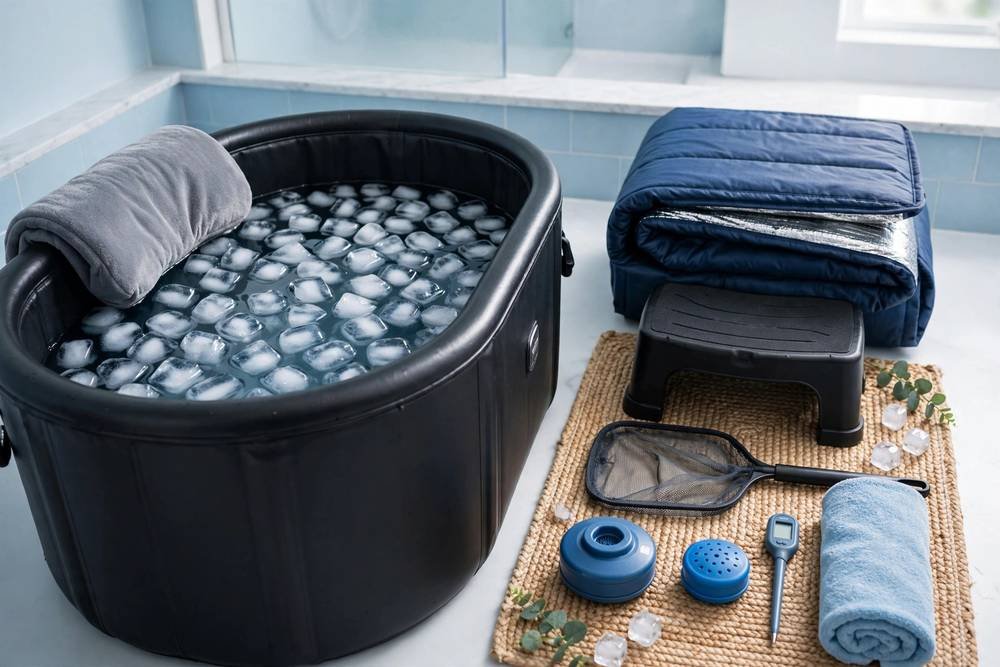
If you buy nothing else, buy these three cold plunge accessories: an insulated cover, a waterproof thermometer, and a skimmer net. They protect your water, your wallet, and your shins. Everything else on this list is a comfort or convenience upgrade — and the three items in the “skip” section are things I genuinely wish someone had talked me out of.
The first time I set up my cold plunge, I bought exactly two things: the tub and a bag of ice. Within a month I had added a cover, a thermometer, a step stool, and a skimmer net — and I had quietly returned a “plunge aromatherapy kit” that did absolutely nothing except make my bathroom smell like a candle shop.
Here is what nobody tells you about cold plunge accessories: a small handful genuinely change the experience. They keep your water cleaner, your temperature steadier, and your daily plunge safer and more comfortable. The rest is clever marketing aimed at your wallet. This guide is the honest version — seven add-ons worth buying, three to skip, and a quick checklist so you buy once and buy right.
The good stuff7 Cold Plunge Accessories Actually Worth Your Money
Insulated Cover
WORTH IT
If your tub lives outdoors — or even in a garage — a cover is the single highest-impact accessory you can own. An uncovered tub bleeds cold into the air, collects leaves, dust, and curious insects, and turns into a safety question if you have kids or pets around. A good insulated cover slows heat transfer dramatically, which means less ice, less chiller runtime, and water that stays clean between sessions.
What to look for
A cover that fits snugly with no big gaps, some real insulation (not a glorified tarp), sturdy handles, and straps or locks if wind is a factor where you live. If you are still choosing a tub, check what is included in the box first — our cold plunge tub buying guide walks through what a complete setup should come with, so you do not pay twice for the same accessory.
Peak tip: put the cover on immediately after every session, not “later.” Ten uncovered hours on a warm day can undo the cold you spent all morning building.
Waterproof Thermometer
WORTH IT
Your body is a terrible thermometer. Water that “feels fine” on a hot day might be 4°C or 15°C, and that difference matters — for safety, for consistency, and for actually knowing whether your protocol is doing what you think it is. Guessing the temperature is how people accidentally plunge far colder than intended.
A simple floating thermometer or a digital probe on a string costs very little and removes all the guesswork. You will use it before every single session, which puts it in rare company among accessories. We break down the options — floating, digital, infrared, and built-in sensors — in our guide to the best thermometer for cold plunge setups.
Why it matters: consistent temperature readings let you repeat the same session day after day. Without one, you are running a different experiment every morning and calling it a routine.
Non-Slip Step or Mat
WORTH IT
Getting into an ice bath is awkward at the best of times. Add wet feet, numb toes, and the adrenaline of cold exposure, and a slippery edge becomes a genuine hazard. A small sturdy step stool solves the “how do I gracefully climb into this thing” problem for taller tubs, and a non-slip mat under and around the tub keeps the whole area safe.
What to look for
A step with a wide, stable base and a textured top — wobble is the enemy. For the mat, anything waterproof with real grip works; it also protects your floor or deck from the puddle that follows every session. This is the least glamorous item on the list and one of the most practical.
Skimmer Net
WORTH IT
Hair, leaves, dust, the occasional drowned insect — open water collects life’s debris with impressive enthusiasm. A twenty-second skim before each plunge keeps the water inviting and stretches the time between full water changes. It is the cheapest accessory on this list and one of the most-used.
A fine-mesh hand skimmer (the kind made for pools or aquariums) is all you need; hang it on a hook next to the tub so it becomes part of the ritual. Pair it with a simple maintenance routine — our cold plunge maintenance guide covers the full weekly checklist — and your water will stay clear far longer than you expect.
Water Test Strips
WORTH IT
If you sanitize your water — and you should, unless you enjoy changing it constantly — test strips are how you know your sanitizer is actually working. Too little and the water turns cloudy; too much and your skin and eyes pay for it. Guessing is not a strategy.
A tube of multi-parameter strips costs less than a bag of ice and lasts for months. Dip, wait, compare the colors, adjust. It takes under a minute. For the full picture on keeping plunge water safe without overdoing chemicals, see our cold plunge water treatment walkthrough.
Peak tip: test on a schedule — say, every Sunday — rather than waiting until the water looks off. By the time it looks off, you are already behind.
Headrest or Bath Pillow
WORTH IT
Cold is the point; neck strain is not. If your tub has a hard rim, two minutes in can turn into an exercise in finding a comfortable head position instead of relaxing into the cold. A suction-cup or strap-on bath pillow gives your neck somewhere to rest, which makes longer sessions genuinely more pleasant.
What to look for
Waterproof materials that will not go manky, strong suction cups or adjustable straps, and a shape that fits your tub’s rim. It will not make you tougher — it will make you consistent, and consistency is what actually delivers results.
A Simple Timer
WORTH IT
Cold distorts your sense of time. What feels like three minutes is often ninety seconds — and what feels like “just a bit longer” can quietly become too long. A timer keeps your sessions honest and repeatable, which is the whole foundation of a protocol you can actually progress.
You do not need anything fancy: a cheap waterproof timer, a kitchen timer in a zip bag, or your phone in a dry pouch all work. Start it when your shoulders go under, stop when it beeps. Boring? Yes. Effective? Completely.
Why it matters: progressive overload applies to cold exposure too. You cannot progress what you do not measure — time and temperature, every session.
Save your money3 Cold Plunge Accessories to Skip
Overpriced “Plunge” Towels
SKIP IT
A towel is a towel. Some brands sell ordinary towels with a plunge-themed logo at triple the price of the exact same towel without the branding. Warm, dry, and absorbent is the entire job description — your bathroom linen cupboard already has several qualified candidates.
If you want an upgrade that actually matters, put the money toward a warm changing robe for winter plunging. That keeps you warm while you dry off, which a logo never will.
Gimmicky Gadgets
SKIP IT
Every niche grows its own ecosystem of novelty products, and cold plunging is no exception: aromatherapy diffusers “for your ice bath,” vibrating massage doodads, LED light shows, and mystery “plunge enhancers” with more adjectives than functions. Ask one question about any of them: does this change the water, the temperature, the safety, or the comfort of my session?
If the honest answer is no, it is decoration with a price tag. The fundamentals — cold water, a safe setup, a consistent routine — do all the work. Everything else is noise.
Redundant Duplicates
SKIP IT
A second thermometer “just in case.” A backup cover for the cover. An “upgrade kit” containing things your tub already included in the box. Before buying any accessory, check what you already own — many tubs ship with covers, thermometers, and repair kits that buyers forget about and then purchase again.
The rule
Inventory first, purchase second. The most wasteful accessory is the one you already had.
Buy once, buy rightThe 60-Second Buyer’s Checklist
- Start with the big three. Insulated cover, waterproof thermometer, skimmer net — these cover temperature, measurement, and cleanliness.
- Add safety next. A non-slip step or mat if your tub is tall or your floor is slick.
- Then water quality. Test strips if you sanitize (and a maintenance routine to go with them).
- Finish with comfort. Headrest and timer — small upgrades that make daily plunging sustainable.
- Check the box first. Look at what your tub already includes before buying anything.
- Skip the branding tax. If a generic version does the identical job, buy the generic version.
- One in, one rule. Every new accessory should earn its place by improving safety, water quality, comfort, or consistency.
Wrapping upFinal Word
The best cold plunge accessories are boring. Covers, thermometers, nets, and test strips will never look exciting in a product photo, but they are the reason some people plunge happily every day for years while others quit after a month of murky water and guesswork.
Buy the unglamorous stuff first. Skip the rest without regret. And if you are still assembling your setup, our cold plunge tub buying guide will make sure the tub itself — the most important “accessory” of all — is the right one.
Questions, answeredFrequently Asked Questions
What accessories do I need for a cold plunge?
At minimum: an insulated cover, a waterproof thermometer, and a skimmer net. These three handle temperature retention, accurate measurement, and basic cleanliness. Add a non-slip step or mat for safety and water test strips if you sanitize your water. Everything beyond that is comfort or convenience — nice to have, not need to have.
Do I need a cover for my ice bath?
Yes — a cover is the single most useful cold plunge accessory, especially outdoors. It slows warming, keeps out leaves, dust, and insects, reduces how much ice or chiller energy you need, and adds a layer of safety around children and pets. If your tub did not include one, it should be your first purchase.
What is the best thermometer for a cold plunge?
The best thermometer for a cold plunge is whichever waterproof one you will actually use every session — a simple floating thermometer or a digital probe on a string both do the job well. Accuracy within a degree or two is plenty for tracking your protocol. Avoid relying on built-in chiller displays alone, since they measure the unit’s water, not necessarily the water around your body.
How do I keep my cold plunge water clean without changing it constantly?
Combine four habits: keep it covered between sessions, skim debris before each plunge, sanitize appropriately, and verify with water test strips on a weekly schedule. This routine — covered in detail in our maintenance guide — can stretch a single fill for weeks instead of days.
Are cold plunge accessories worth the money?
The practical ones are. A cover, thermometer, skimmer net, and test strips all pay for themselves by saving ice, extending water life, and keeping sessions safe and consistent. Branded luxuries and gimmicky gadgets generally are not worth it — they add cost without changing the water, the temperature, or your safety.
What should I avoid buying for my ice bath?
Skip overpriced branded towels (any towel works), gimmicky gadgets that do not affect water, temperature, safety, or comfort, and duplicate items your tub may already include — many tubs ship with covers or thermometers in the box. When in doubt, inventory what you own before buying anything new.

Related Articles
Cold Plunge Thermometer: 7 Ways to Measure Water Temperature Accurately
GEAR LAB · MEASUREMENT The 60-Second Read Your cold plunge thermometer is the most underrated piece of gear…
Read Guide
Cold Plunge Water Treatment: 5 Ways to Keep Your Water Clean and Safe
Safety note before you read on: This guide covers general cold plunge water treatment options, including filters, UV…
Read Guide
Best Portable Cold Plunge: What to Look for Before You Buy
A quick note before you read on: This guide covers what to look for and general expectations when…
Read Guide