
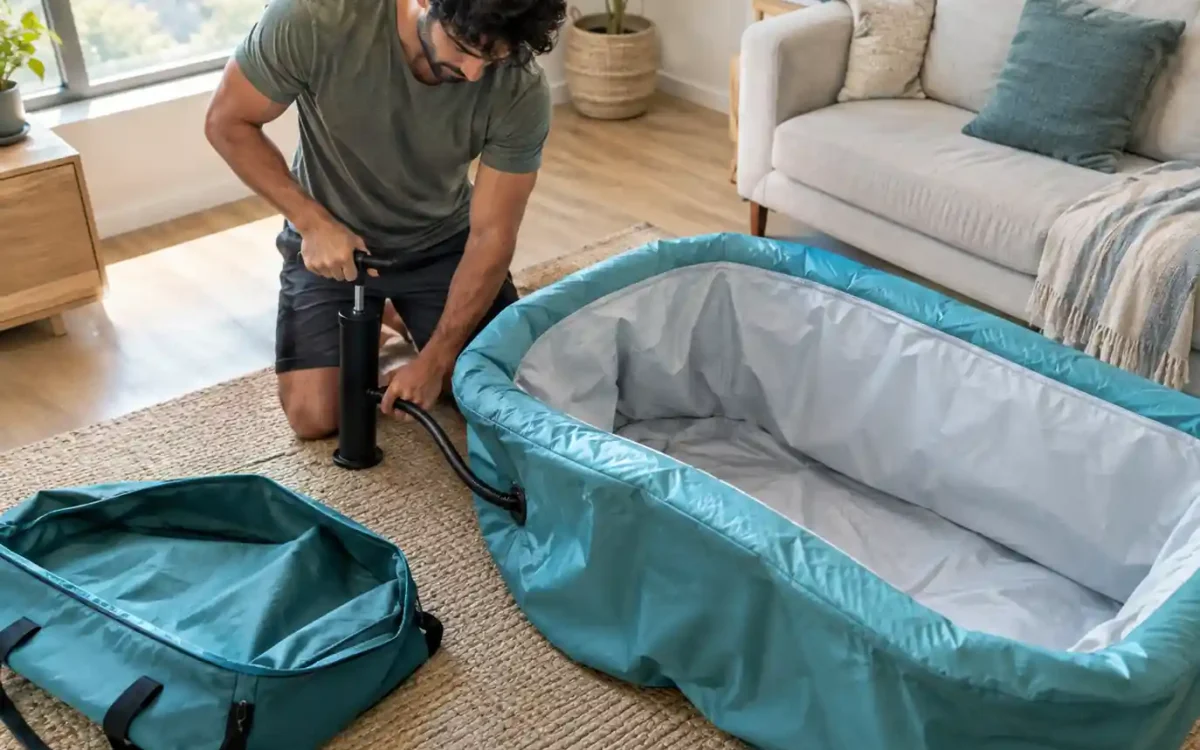
A friend of mine moves apartments roughly once a year, and the first thing she asked when she got serious about cold plunging wasn’t which tub was the fanciest — it was whether a best portable cold plunge even existed that wouldn’t turn into dead weight during her next move. That question turns out to matter to a lot more people than just frequent movers: apartment dwellers with limited storage, athletes who travel for competitions, and anyone who simply wants to try cold plunging before committing to a permanent setup all land on the same search. This guide walks through what actually makes a cold plunge portable, what to expect at different price points, and how to pick one that fits your specific situation.
The market for these has grown quickly enough that “portable” now covers a fairly wide range of products, from genuinely backpack-sized inflatables to heavier folding tubs that are portable mostly in the sense that they’re not permanently plumbed in. Knowing which category you actually need before you start comparing specific models saves a lot of back-and-forth later in the buying process.
What Makes a Cold Plunge Tub Actually Portable?
“Portable” gets used loosely in this space, so it helps to separate what it actually means in practice. A genuinely portable tub should deflate or fold down small enough to fit in a closet or car trunk, weigh little enough that one person can carry it without strain, and set up again in well under half an hour without special tools.
Typical empty weight
Typical setup time
Typical water capacity
Those numbers vary a fair amount by model and style, but they’re a useful baseline for comparing any specific tub you’re considering against. When a listing seems unusually light or unusually fast to set up compared to these ranges, it’s worth double-checking whether that number includes the chiller unit or just the tub itself, since sellers don’t always make that distinction obvious.
Best Portable Cold Plunge Types Compared
Inflatable vs portable cold plunge is a bit of a misleading framing, since most inflatable models are the most portable category, but they’re not the only option worth knowing about.
| Type | Weight | Best For | Trade-off |
|---|---|---|---|
| Inflatable | Lightest (under 20 lbs typical) | Travel, frequent moves, tight storage | Walls can feel less rigid; occasional air leaks over time |
| Rigid Foldable | Moderate (20-45 lbs) | Semi-permanent home use with occasional moves | Bulkier to pack than inflatable, sturdier feel |
| Compact Rigid | Heaviest of the “portable” category | People who want durability over ultra-portability | Two-person carry often needed |
If you’re still deciding between a portable setup and a fixed, more permanent one entirely, our cold plunge tub buying guide covers that broader decision in more depth.
Within the inflatable category itself, there’s a meaningful quality range worth knowing about before you shop. Single-wall inflatable designs tend to be the lightest and cheapest but can feel less stable when you sit on the edge to get in and out. Double-wall or drop-stitch construction adds a small amount of weight in exchange for noticeably firmer sides, which is usually worth the trade-off unless minimizing weight is your single top priority.
Outside the inflatable world entirely, a handful of rigid, foldable designs exist as a middle ground — sturdier than an air-filled tub but still light enough to move without a second person for most healthy adults. These tend to cost a bit more than a comparable inflatable but hold their shape noticeably better over months of regular use.
How Much Do Portable Cold Plunge Tubs Weigh?
Empty weight is the number that actually matters for portability, since a full tub is never something you’re meant to move. Most lightweight cold plunge tub models land somewhere between 9 and 45 pounds when drained, with the lightest inflatable options sitting at the low end and rigid or double-walled designs at the higher end. If you’ll regularly be moving the tub yourself without help, staying under 30 pounds empty is a reasonable target to keep it a one-person job.
It’s worth actually testing this in your own space before assuming a listed weight will feel manageable. Carrying a 30-pound deflated tub down a single flight of stairs is a different experience than carrying it up three flights to a walk-up apartment, and packed dimensions matter just as much as raw weight if you’re navigating narrow hallways or a small elevator.
Best Portable Cold Plunge for Small Apartments
Best cold plunge for small apartments usually comes down to storage footprint more than anything else. An inflatable model that packs into a bag roughly the size of a duffel solves the biggest apartment-living problem: not having a dedicated corner of the garage to permanently dedicate to a tub. Look specifically at the packed-down dimensions listed by the manufacturer, not just the inflated size, since that’s the number that determines whether it actually fits your closet.
Water access is the other apartment-specific consideration people tend to overlook. Filling a tub from a bathtub faucet with a hose adapter works fine for most inflatable models, but draining is where apartments get trickier — a lot of buyers end up needing a small submersible pump to drain into a sink or tub rather than relying on gravity alone, so it’s worth checking whether that’s included or needs to be bought separately as an add-on.
Taking a Cold Plunge Tub Camping or On a Road Trip
Can you take a cold plunge tub camping is a question that comes up a lot among people who already own a portable setup, and the honest answer is: yes, with some planning. You’ll need a water source nearby to fill it and a way to drain it responsibly afterward, plus a cold-enough ambient temperature or ice to actually make the session worthwhile without an external chiller running on generator power. For a shorter road trip where you have access to a hose and an outlet, it’s considerably more straightforward.
Setup surface matters more outdoors than it does at home. A flat, debris-free patch of ground protects the base of an inflatable tub from punctures, and a lot of portable models come with or recommend a separate ground cover for exactly this reason. Skipping that step is one of the more common, easily avoidable ways an otherwise sturdy tub develops a leak within its first few outdoor uses.
Confirm packed dimensions fit your vehicle or storage space
Bring the repair kit most inflatable tubs ship with
Plan your water source and drainage before you leave
Pack ice separately if you won’t have chiller power on site
A short trial run at home before your first trip is worth the extra half hour. Practicing the full setup and breakdown once in your own space means you’re not troubleshooting an unfamiliar valve or fill hose for the first time somewhere without easy access to a hardware store or a spare part.
Portable Cold Plunge Cost: What to Expect
Best portable cold plunge under $1,000 is a realistic target if you’re looking at a basic inflatable tub without an integrated chiller — you’ll rely on ice instead. Add a dedicated portable chiller and filtration, and total cost typically climbs well past that mark. If you’re weighing that trade-off against building your own setup piece by piece, our DIY cold plunge setup guide breaks down the component costs in more detail, and our broader best cold plunge gear roundup covers accessories worth pairing with any portable tub.
Ice-only setups do come with an ongoing cost that’s easy to underestimate at first. Filling a large tub with enough ice for a proper cold session multiple times a week adds up meaningfully over a few months, which is exactly why a lot of frequent users eventually decide a chiller pays for itself even at the higher upfront price, especially once travel time to buy ice repeatedly is factored in too.
While looking into this for my friend, what stood out most wasn’t any single spec sheet, it was how consistently reviewers who’d actually traveled with their tubs mentioned the same small annoyance: forgetting the repair kit or the drain adapter at home on the one trip they actually needed it. The tubs themselves held up fine in most accounts. It was almost always the accessories, not the tub, that made or broke the travel experience.
She ended up going with a simple single-wall inflatable in the end, mostly because it genuinely fit in the closet of her current apartment without rearranging anything. It wasn’t the most durable-sounding option on paper, but it was the one she was actually going to use consistently, which mattered more in the end than any spec sheet could.
Frequently Asked Questions
Inflatable models genuinely pack down to backpack or duffel-bag size and can weigh under 20 pounds empty, making them realistically portable for regular travel, not just marketing language.
For the core experience, yes — the water still gets just as cold. The trade-offs are typically wall rigidity and long-term durability, not the actual cold plunge effectiveness.
Basic inflatable tubs without a chiller can be found under $1,000, while models with an integrated portable chiller typically cost considerably more.
Yes, as long as you plan for a water source, a way to drain it, and either chiller power or enough ice to reach a usable temperature.
Most inflatable models take roughly 15 to 20 minutes to inflate and fill, not counting the time it takes the water to actually reach a cold temperature.
Would a tub that packs into a bag actually get used more often than one that never leaves the garage?
For a lot of people chasing consistency over perfection, the best portable cold plunge isn’t the fanciest one — it’s the one that’s easy enough to set up that it actually gets used.

Related Articles
Cold Plunge Water Treatment: 5 Ways to Keep Your Water Clean and Safe
Safety note before you read on: This guide covers general cold plunge water treatment options, including filters, UV…
Read GuideCold Plunge Maintenance Tips: How to Keep Your Tub Clean and Safe
A quick note before you read on: This article is for general educational purposes and reflects common maintenance…
Read Guide
Inflatable Cold Plunge Tub: Is It Actually Worth Buying?
This article is for general informational purposes only. Product durability and performance can vary by manufacturer and how…
Read Guide