
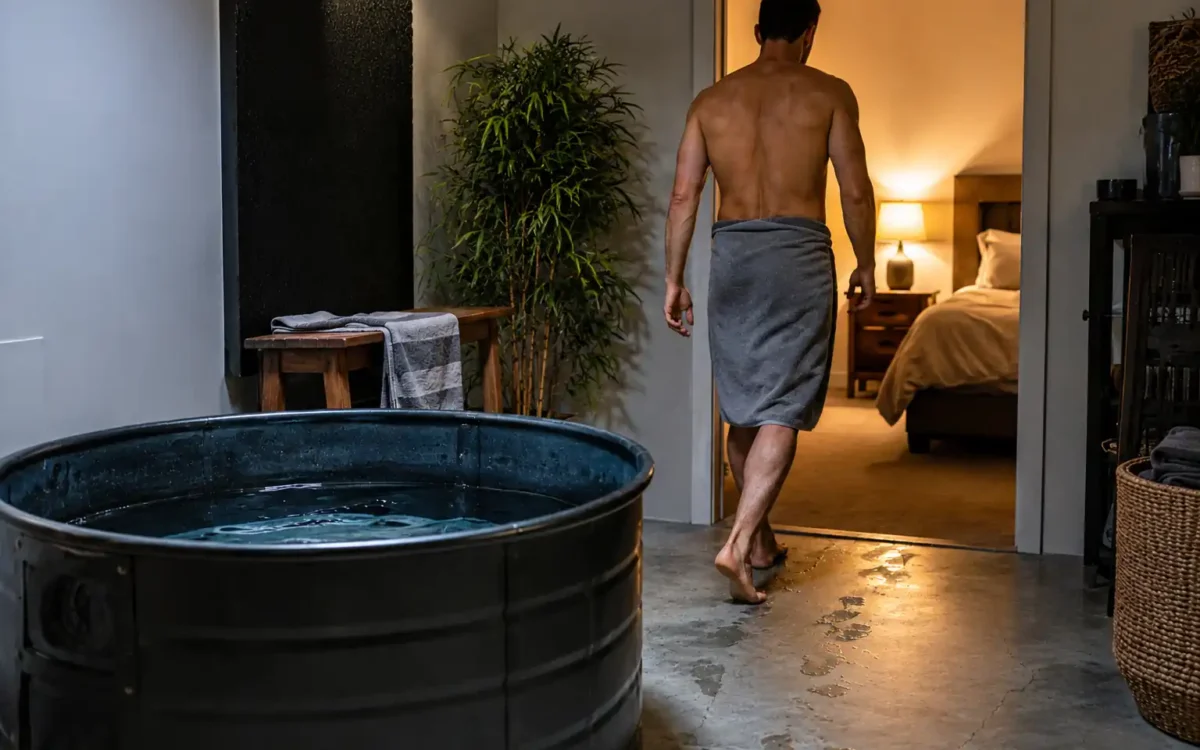
You step out of the cold water, towel off, and within a few minutes your skin feels almost hot to the touch even though the room hasn’t changed temperature. That warm, slightly drowsy rebound is at the center of the real story behind cold plunge for better sleep — and it has almost nothing to do with the cold itself.
The Mechanism Nobody Explains Properly
Most articles stop at “cold water relaxes you,” which skips the actual biology. Cold water immersion drops your core temperature, and as your body works to rewarm afterward, it triggers peripheral vasodilation — blood vessels near the skin widen, releasing heat outward.
That warm-skin, cooling-core pattern is exactly what your brain uses every night to recognize that sleep is approaching. In other words, does cold plunge help you sleep comes down to borrowing a signal your body already sends itself naturally at bedtime, just triggered earlier and more deliberately.
It’s a useful reframe because it explains why the cold part matters less than people assume. The plunge itself is really just the trigger; the actual sleep-relevant event happens afterward, during the twenty or thirty minutes your body spends rewarming.
This is also why a very brief, extremely cold dip and a slightly longer, milder one can produce a similar sleep-supporting effect — what matters most is that a genuine rewarming phase actually happens afterward, not the exact number on the thermometer during the plunge itself.
What Actually Happens to Melatonin and Cortisol
Cold plunge and melatonin is one of the more interesting angles here. Some research suggests cold exposure may support melatonin production, the hormone that signals your body it’s time to wind down.
Cortisol tells a slightly different story. The initial shock of cold water spikes cortisol briefly, but that spike tends to burn off quickly, sometimes leaving evening cortisol lower than it would have been without the plunge. Elevated melatonin paired with subdued cortisol is close to the hormonal pattern researchers associate with easier sleep onset — though individual responses vary.
None of this means cold plunging replaces your body’s normal hormonal rhythm — it’s more accurate to think of it as giving that rhythm a nudge in the right direction at a specific point in your evening, rather than overriding it entirely.
There’s also a connection worth mentioning between cold exposure and cold plunge and deep sleep specifically. Some athletes who track their sleep stages have reported spending more time in deep, restorative sleep on nights following a cold plunge, though this is based on limited self-reported data rather than large controlled trials, so it’s best treated as an encouraging pattern rather than a proven guarantee.
Timing Matters More Than the Temperature
Best time to cold plunge for sleep isn’t a fixed rule, but the research points toward a fairly specific window rather than “anytime works.”
Cold plunge before bed vs morning comes down to your goal: morning sessions support alertness and circadian rhythm from a distance, while a session roughly 1–2 hours before bed lines up with the rewarming window finishing right as you’re heading to sleep. Doing it minutes before lying down risks the opposite effect — lingering adrenaline and norepinephrine can leave you wired instead of relaxed.
| Time of Day | Primary Effect | Best For |
|---|---|---|
| Morning | Alertness, energy, circadian cueing | Daytime focus and mood |
| Afternoon | Moderate stress relief, mild recovery | General wellness routines |
| 1–2 Hours Before Bed | Rewarming signal aligns with sleep onset | Cold plunge for better sleep specifically |
Notice that the table isn’t ranking one time slot as universally “best” — each serves a different purpose. If sleep is your main goal, the evening window is the one worth prioritizing; if energy and focus matter more to you day to day, morning sessions likely serve you better even if the sleep effect is smaller.
What the Research Actually Shows
It’s worth being honest about the evidence here rather than overselling it. A systematic review pooling data from multiple studies and thousands of participants found cold-water immersion linked to reduced stress and somewhat better sleep outcomes — but the sleep-specific data was drawn largely from male participants, which limits how confidently it applies to everyone.
That doesn’t mean the effect isn’t real; it means the research is still catching up to how widely people are already using cold plunging this way. Treating it as a promising tool rather than a guaranteed fix is the more accurate — and more useful — way to think about it.
It’s also worth noting that cold plunge sleep benefits likely aren’t identical for everyone. Age, baseline stress levels, existing sleep habits, and even how your body handles cold in general all shape how much of a difference this actually makes for you personally, which is part of why self-tracking tends to be more useful than any single study’s average result.
For people specifically looking into cold plunge insomnia help, it’s worth setting realistic expectations upfront. Cold exposure may ease some of the stress and hyperarousal that keeps people awake, but chronic insomnia often has multiple contributing causes, and a cold plunge addresses only one small piece of that picture.
Cold Plunge and Your Nervous System Before Bed
Cold plunge parasympathetic nervous system activation is the other half of this story. After the initial jolt, your body shifts from fight-or-flight into rest-and-digest mode — slower heart rate, calmer breathing, and a general dial-down in alertness.
This shift is also why anyone managing a heart-related condition should be more cautious with evening sessions specifically, since the same nervous system swing that helps most people relax puts extra demand on a heart that’s already working with less margin. Our guide on cold plunge and heart conditions is worth reading before adding a nightly cold plunge routine if that applies to you.
For most people without that concern, this nervous system shift is exactly the point — it’s the physiological version of consciously stepping on the brakes after a day spent mostly in drive.
That braking effect tends to be more noticeable on days when stress was already running high, which makes sense — there’s simply more nervous system activation to bring back down. On calmer days, the shift is subtler, which is worth knowing so you don’t judge the practice unfairly based on one unremarkable evening.
Building This Into an Actual Evening Routine
Consistency does more here than intensity. A short, moderate session on a predictable schedule tends to outperform an occasional extreme one, since your body responds to a repeated bedtime signal, not a single dramatic data point.
If you’re also using cold plunging around exercise, the timing logic overlaps more than people expect — our guide on cold plunge before or after workout walks through how to sequence cold exposure around training without the two goals working against each other. And if you’re unsure what temperature actually fits an evening session, our cold plunge temperature chart breaks down ranges by goal so you’re not guessing.
A realistic starting point looks less like a strict protocol and more like a habit you can actually keep: pick a time roughly two hours before your usual bedtime, keep the session brief, and give it at least a week or two before deciding whether it’s making a noticeable difference. Judging it after one session is a common reason people give up on something that might have worked with a bit more consistency, especially given how much sleep quality naturally fluctuates night to night regardless of what you do beforehand.
What Tracking My Own Sleep Actually Showed
I started timing my sessions around two hours before bed mostly out of curiosity, using a basic sleep tracker to see if anything changed. The data wasn’t dramatic, but it was consistent: nights with an evening plunge showed slightly faster time to fall asleep compared to nights without one. It wasn’t a transformation — it was a small, repeatable nudge, which honestly felt more believable than a miracle claim would have.
What surprised me more was how much the timing mattered compared to the temperature. A colder-but-badly-timed session did noticeably less than a milder one done consistently at the same time each evening — which lines up with everything the research suggests about consistency over intensity. It’s a small enough experiment that anyone curious could run the same version on themselves in a week or two.
Frequently Asked Questions
For many people, yes — the rewarming effect after a cold plunge mimics the natural temperature drop your body associates with sleep onset, though individual results vary.
Roughly 1 to 2 hours before bed tends to work best, giving the rewarming response time to finish right as you’re ready to sleep. Sessions done minutes before bed can backfire due to lingering alertness hormones.
It may help by reducing stress and supporting a lower evening cortisol level, but it isn’t a clinical treatment for insomnia and shouldn’t replace medical guidance for persistent sleep issues.
Most people do better with a 1–2 hour buffer rather than plunging immediately before lying down, since the initial cold shock briefly raises alertness before the calming rebound sets in.
Some research suggests cold exposure may support melatonin production, though study sizes are still limited and more research is needed to confirm how consistent this effect is across different people.
What Does Your Evening Actually Look Like?
If falling asleep is the real goal, would a short cold plunge two hours before bed fit into your evening — or would it just be one more thing competing with the wind-down you already have?

Related Articles
Cold Plunge and Cortisol: 7 Science-Backed Facts About Stress Hormones
Stress Hormones · Benefits & Science Is your ice bath calming you down — or secretly stressing you…
Read Guide
Cold Plunge and Brown Fat: The Honest Science on Weight Loss and Metabolism
Medical Disclaimer: This article is for general information only and is not medical advice. Talk to a qualified…
Read Guide
Cold Plunge for Athletes: Recovery, Timing, and Performance Guide
A quick note before you read on: This article shares general training and recovery guidance and isn’t medical…
Read Guide