
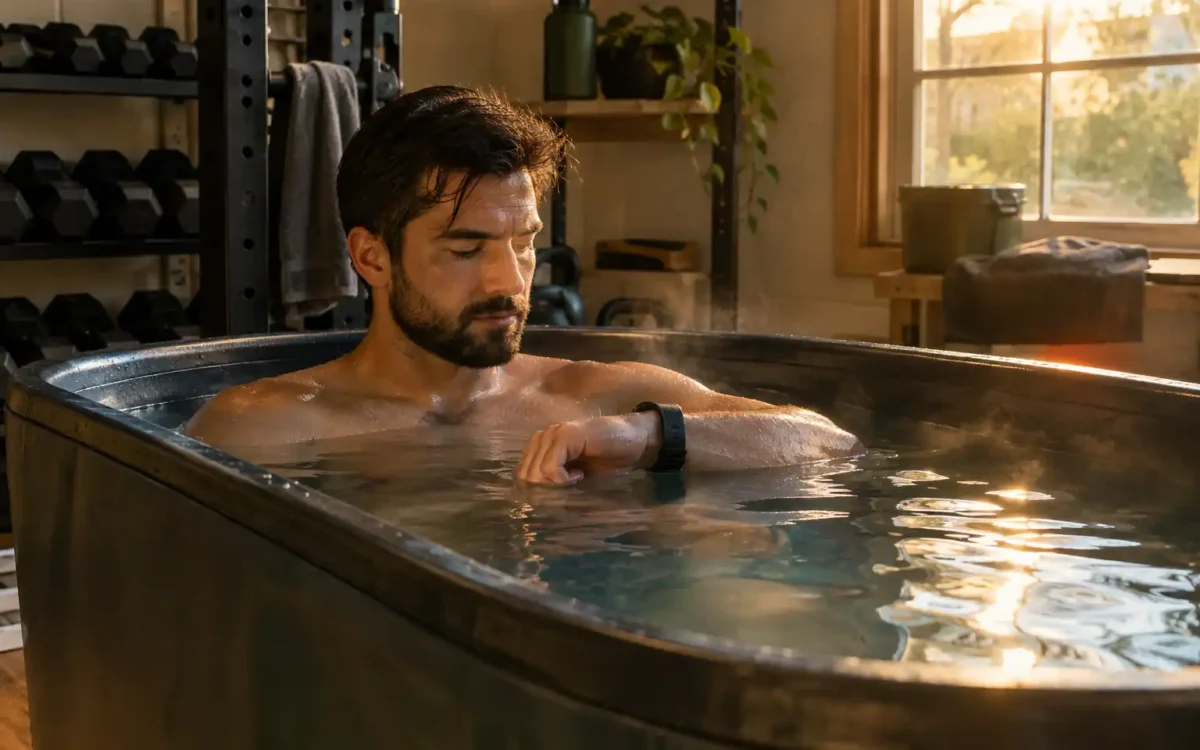
Here’s a number that surprises most beginners: research popularized by recovery scientist Dr. Susanna Søberg suggests that just eleven total minutes of cold exposure a week is enough to trigger meaningful metabolic and mood benefits (see cold-water immersion research on PubMed). Not eleven minutes a day. Eleven minutes a week. So if you’ve been wondering how long should you cold plunge and assumed the answer involves gritting your teeth for ten straight minutes, the real answer is both simpler and more forgiving than that. This guide breaks down exactly how long to stay in based on your experience level, the water temperature, and what you’re actually trying to get out of it.
Part of the confusion comes from social media, where the loudest videos are usually the extreme ones — someone gritting through eight or ten minutes in near-freezing water while captions imply that’s the standard to aim for. It isn’t. Most of the actual benefit people chase, from better mood to faster recovery, shows up well within the first few minutes, and pushing far past that point adds risk without adding much upside. Once you understand the real relationship between time, temperature, and your own experience level, picking a duration stops being guesswork. That’s the real answer to how long should you cold plunge: it depends, but less than you think.
How Long Should You Cold Plunge as a Beginner?
If this is new territory for you and you’re wondering how long should you cold plunge, duration matters far less than simply showing up consistently. Most coaches and cold-exposure researchers agree on a similar progression, even if the exact numbers vary slightly from source to source. Your nervous system needs repeated, manageable exposures to actually adapt — a single brutal first attempt teaches your body nothing except to dread the next one.
The first ten to fifteen seconds are usually the hardest part of any session, beginner or not — that’s the cold shock response kicking in, and it’s normal for your breathing to go shallow and rapid in that window. What separates people who stick with cold plunging from people who quit after one attempt is what happens next: instead of fighting the reaction, slow, controlled exhales help your body move past that initial jolt within seconds. A short, calm session where you stay in control beats a longer session where you’re white-knuckling the clock every single time.
Notice that even the “experienced” tier tops out around ten minutes. Beyond that point, most researchers agree the added benefit flattens out while the risk of overcooling climbs, which is exactly why more isn’t the goal here. So how long should you cold plunge once you’re experienced? About ten minutes max — the ladder above is the full progression. If you’re brand new to this altogether, our guide to starting cold plunging covers the first-session basics that pair well with this duration ladder.
How Long Should You Cold Plunge? Duration by Temperature
When people ask how long should you cold plunge, the honest follow-up is: at what temperature? Duration and temperature aren’t separate decisions — they move together. The colder the water, the shorter your session should be, and pushing a long session in very cold water is one of the fastest ways to turn a beneficial practice into an uncomfortable, even risky one.
59–65°F (15–18°C)
Mild range. Sessions of 5–10 minutes are generally well tolerated.
50–59°F (10–15°C)
The most common home cold plunge range. 2–5 minutes is typical.
39–50°F (4–10°C)
Genuinely cold. 1–3 minutes is plenty for most people.
Below 39°F (4°C)
Advanced territory. Seconds to low minutes, experienced users only.
If you’re not yet sure which range your setup falls into, or you’re deciding what to aim for, our cold plunge temperature guide lays out the full range in more detail alongside what each band actually feels like — useful context when you’re deciding how long should you cold plunge at your temperature.
Immersion depth changes this equation slightly too. Neck-deep immersion pulls heat away from your body faster than a chest-level plunge does, simply because more surface area is exposed to cold water at once. If you’re plunging up to your neck, treat the shorter end of whichever temperature band you’re in as your realistic target rather than the longer end — you’ll get a strong response without needing to chase extra minutes.
The 11-Minute Weekly Rule
total minutes of cold exposure per week, spread across multiple sessions, is the commonly cited target for meaningful metabolic and mood benefits.
This is arguably more useful than obsessing over any single session’s clock when you’re deciding how long should you cold plunge each time. Three sessions of about four minutes, or four sessions of under three minutes, both land you in roughly the same place. It also removes the pressure to “win” any individual plunge — a shorter session on a rough day still counts toward the weekly total, and that framing tends to make the habit far easier to sustain long-term than chasing a personal-best time.
It’s worth noting that eleven minutes is a target, not a strict ceiling or a magic threshold where benefits suddenly switch on. Some weeks you might land at eight minutes because life got in the way, and other weeks you might comfortably clear thirteen or fourteen. What actually matters more than hitting an exact number is the pattern over time — regular, moderate cold exposure spread across the week consistently outperforms one long session followed by weeks of nothing. So if you’re asking how long should you cold plunge per session, the weekly total matters more than any single stopwatch reading.
How Long Should You Cold Plunge for Different Goals?
How long should you cold plunge for muscle recovery? It isn’t quite the same answer as how long to plunge for a mood or focus boost, even though the ranges overlap. For general recovery and reduced soreness after training, most people land in the 2–5 minute window, ideally a few hours away from resistance training rather than immediately after a heavy lifting session, since very early post-lift cold exposure may blunt some strength-building signals.
For mental clarity, stress relief, and the mood lift that draws a lot of people to cold plunging in the first place, shorter sessions of around 1–3 minutes, done consistently, tend to be enough — the nervous-system response that drives the mood effect happens early in the exposure, not late.
If cold plunge duration for weight loss is your main interest, it’s worth setting expectations honestly: cold exposure can modestly support metabolic rate and brown fat activity over time, but duration alone won’t outperform basic training and nutrition habits. Treat it as a supporting piece, not the main lever.
Timing matters just as much as length for some goals. If better sleep is part of why you’re plunging, keep sessions on the shorter side and finish at least a few hours before bed — cold exposure raises alertness in the short term, which is useful in the morning but can work against you late at night. There’s no need to extend a session just because you’re chasing a specific outcome; in almost every case, consistency at a shorter duration beats occasional long sessions aimed at a single goal. That’s true whether you’re asking how long should you cold plunge for sleep, recovery, or mood.
Mistakes That Push People Past a Safe Cold Plunge Duration
Most duration mistakes fall into one of two camps: people who bail out after fifteen panicked seconds and never build tolerance, or people who treat “longer is better” as a badge of honor and push well past what’s useful. Neither extreme serves you well.
There’s also a subtler mistake worth mentioning: staying in purely out of stubbornness after your body has already signaled it’s had enough. Numbness in fingers and toes, uncontrollable shivering, or a sudden wave of dizziness aren’t signs of toughness — they’re your body telling you the session is over, regardless of what the clock says. Learning to tell the difference between “uncomfortable but fine” and “time to get out” is a skill that matters more than any specific answer to how long should you cold plunge.
| Do | Don’t |
|---|---|
| Build duration gradually over several weeks | Jump straight to a 10-minute session on day one |
| Focus on slow, controlled exhales throughout | Hold your breath through the cold shock response |
| Exit while you still feel in control | Push through numbness, dizziness, or uncontrolled shivering |
| Track your weekly total, not just single sessions | Try to “win” one heroic session and skip the rest of the week |
| Rewarm gradually with dry layers | Jump into a hot shower immediately after |
If you’re unsure whether cold plunging is appropriate for you at all given a health condition, our cold plunge safety guide covers who should check with a doctor first before worrying about duration at all. The American Heart Association also offers guidance on heart risk factors worth reviewing.
A friend of mine got into cold plunging around the same time I did, and for the first month he was convinced that staying in longer meant he was “doing it right” — he’d regularly push past eight minutes just to prove a point to himself. He ended up dreading his sessions and eventually stopped altogether for a while. When he came back to it, he switched to short, consistent two-minute plunges instead, and that’s the version that actually stuck. Watching that shift happen taught me more about how long should you cold plunge than any article I’d read up to that point.
Frequently Asked Questions
Most people do well with 2–5 minutes once they’ve built some tolerance, with beginners starting around 30 seconds to 2 minutes and experienced users occasionally extending toward 8–10 minutes.
Yes. Two minutes, done consistently, is well within the range associated with meaningful benefits for anyone wondering how long should you cold plunge to see results, especially when it contributes toward a weekly total like the commonly cited 11-minute guideline.
Yes. Beyond roughly 10 minutes at typical home cold plunge temperatures, added benefit tends to flatten out while the risk of overcooling rises, so longer isn’t automatically better. If you’re asking how long should you cold plunge at most, ten minutes is a sensible ceiling for most home setups.
Extended exposure increases the risk of excessive core temperature drop, which can show up as uncontrolled shivering, numbness, or dizziness — all signs to exit immediately and rewarm gradually.
If you’re asking how long should you cold plunge as a complete beginner, start with 30 seconds to 2 minutes and let your body adapt over several sessions before gradually extending toward the 2–4 minute range.
What’s actually stopping you from starting at 60 seconds this week instead of waiting for the “right” amount of time?
Duration is one of the easiest parts of cold plunging to overthink. Once you know roughly how long should you cold plunge for your current experience level, the rest is just showing up.

Related Articles
Cold Plunge in Winter: 7 Rules for Safe, Comfortable Outdoor Plunging
Winter Guide · Outdoor Plunging The water doesn’t care that it’s January. Everything around it does. A cold…
Read Guide
Cold Plunge vs Cold Shower: Is a Shower Really Enough?
A quick note before you read on: This article compares two wellness practices for general informational purposes and…
Read Guide
Cold Plunge vs Cryotherapy: Which One Is Actually Right for You?
A quick note before you read on: This article compares two wellness practices for general informational purposes and…
Read Guide