
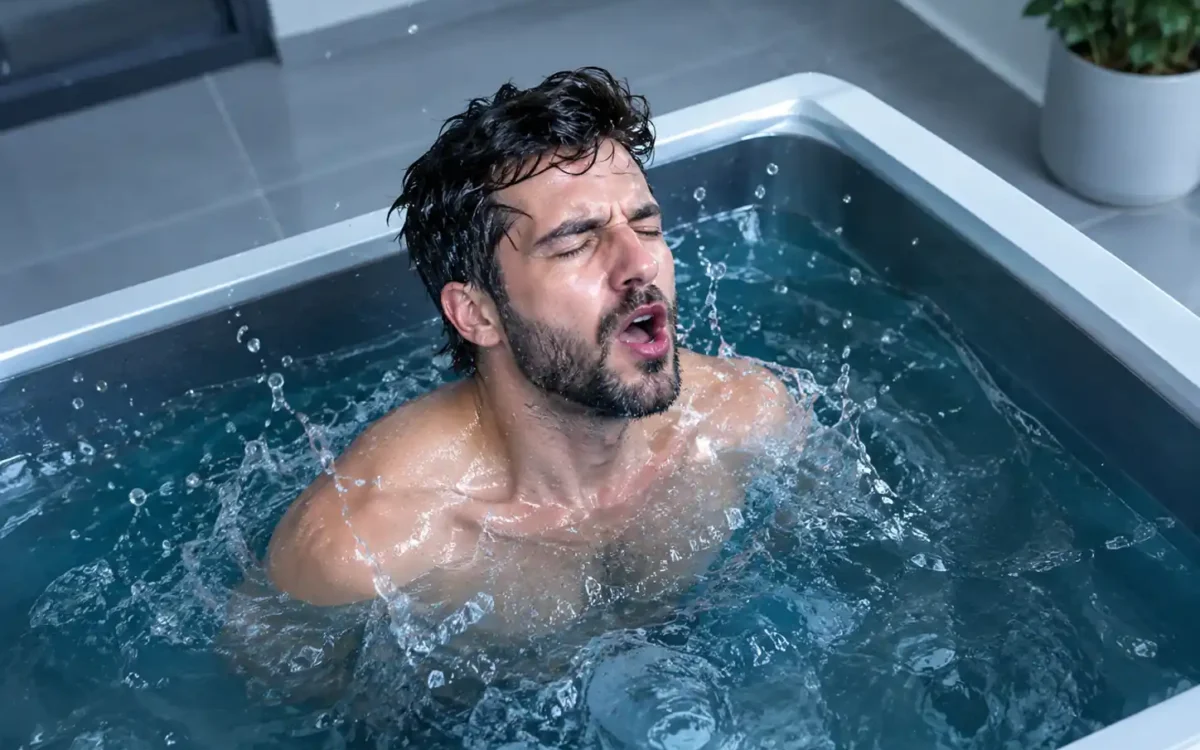
Cold shock response, explained simply: the moment your body hits genuinely cold water, something happens before you’ve even had time to think about it — your breath rips out of you in one involuntary gasp, your chest tightens, and for a few seconds you feel like you’ve completely lost control of your own lungs. That’s not panic, and it’s not weakness. It’s an automatic, protective, entirely predictable reaction that every single person experiences on first contact with cold water. Understanding what’s actually happening in those first sixty seconds changes cold plunging from something frightening into something you can work with.
Most beginners assume something has gone wrong the first time this hits them, simply because nobody warned them it was coming. Once you have the cold shock response explained, that same overwhelming sensation stops feeling like a red flag and starts feeling like exactly what it is: a normal, temporary, well-documented physiological event that fades within minutes.
Cold Shock Response Explained: What It Actually Is
Cold shock response is the name physiologists give to the burst of involuntary reflexes triggered the instant cold-sensitive receptors in your skin register a sudden temperature drop. It isn’t something you choose, and it isn’t something you can simply talk yourself out of — the signal travels through your nervous system faster than conscious thought can intervene. The response typically involves a sharp inhale, a spike in heart rate and blood pressure, and a rush of stress hormones, all firing within seconds of skin contact with cold water. In short, cold shock response explained in one sentence: your nervous system overreacts to sudden skin cooling before your conscious brain catches up.
This matters for a simple reason: if you don’t know this reaction is coming, it feels like something has gone wrong. That’s why getting the cold shock response explained before your first plunge matters more than any gear or technique.
It’s also worth understanding why this reflex exists at all. From an evolutionary standpoint, a sudden burst of alertness and cardiovascular activity on unexpected cold immersion likely helped our ancestors react quickly to genuine danger — falling through ice, or being swept into cold water unexpectedly. In a controlled home cold plunge, that ancient survival wiring fires anyway, even though there’s no real emergency happening. Recognizing that mismatch between an old reflex and a modern, deliberate practice is often what helps people stop dreading it. In a way, the entire cold shock response explained here is a story of old wiring meeting a new habit.
The Gasp Reflex Explained
The very first thing to hit you is the gasp reflex — an involuntary, forceful inhale that happens regardless of how mentally prepared you think you are. It’s triggered by cold receptors in the skin sending an urgent signal up the spinal cord, bypassing the slower, conscious parts of the brain entirely. This is exactly why safety guidance around open cold water always stresses keeping your face above the surface on first entry: an unexpected gasp while submerged is how water ends up in the lungs — the most safety-critical detail in the cold shock response explained here.
In a controlled home cold plunge, the practical takeaway is simpler. Ease in rather than jumping, and expect that first gasp — it passes within a second or two, and fighting it or holding your breath against it usually makes the following minute harder, not easier. That’s the cold shock response explained at its simplest: an involuntary inhale you breathe through, not fight.
Cold Shock Response Explained: Timeline of What Happens Minute by Minute
How long does cold shock response last is one of the most common questions beginners ask. With the cold shock response explained stage by stage, the honest answer is that it follows a fairly predictable arc rather than one single moment.
Initial Gasp
The sharp involuntary inhale and the hardest psychological moment of the entire session.
Hyperventilation Peak
Breathing rate climbs, heart rate and blood pressure are elevated. This is the window where breathing control matters most.
Response Fades
Breathing starts to settle as the initial shock signal weakens and your body shifts toward a steadier state.
Stabilized
For most people, breathing and heart rate are largely back under control by this point, well before cold-related fatigue sets in.
Most sources place the sharpest edge of the cold shock response within the first 30 seconds, with the overall reaction largely resolving within two to three minutes even if you stay in the water longer than that. That’s the full cold shock response explained as a timeline — after this window, you’re dealing with cold, not shock.
Cold Shock Response and Heart Rate
One of the more important pieces of cold shock response and heart rate to understand is that this isn’t a minor blip — heart rate and blood pressure can rise sharply within the first couple of minutes of cold exposure, as your nervous system reacts to the sudden skin cooling.
For most healthy adults this spike is brief and unremarkable. For people with existing cardiovascular conditions, though, that same spike represents genuine added strain on the heart. With the cold shock response explained in cardiac terms, the American Heart Association‘s guidance on heart risk factors is worth reviewing before your first plunge.
If you have any history of heart issues, this is precisely the piece worth taking seriously before starting. Our cold plunge and heart conditions guide goes into more depth on who should check with a doctor first.
It’s worth being clear that this cardiac response isn’t unique to cold plunging specifically — any sudden, intense stimulus can produce a similar spike. What makes cold water distinct is how reliably and quickly it happens, which is exactly why easing in gradually rather than jumping in abruptly gives your cardiovascular system a slightly gentler ramp instead of one sudden jolt. That’s a key practical takeaway from the cold shock response explained above.
Cold Shock Response vs Hypothermia
These two get confused constantly, but they’re genuinely different events on different timelines. Cold shock response vs hypothermia, explained: it comes down to speed and cause — one is an instant nervous-system reflex, the other is a slow, gradual drop in core body temperature.
| Cold Shock Response | Hypothermia |
|---|---|
| Happens within seconds of skin contact | Develops gradually over extended exposure |
| Driven by skin temperature receptors | Driven by dropping core body temperature |
| Resolves within a few minutes for most people | Worsens the longer exposure continues |
| Main risks: gasping, cardiac strain, panic | Main risks: confusion, muscle failure, loss of consciousness |
For a typical short home cold plunge session, cold shock response is the relevant concern, not hypothermia — you’d need a much longer, colder exposure for true hypothermia to become a realistic risk.
How to Control Breathing During Cold Shock
Slow, steady exhales — longer than your inhales — are the single most effective tool for moving through the hyperventilation window faster and with less panic.
The instinct during that first minute is to fight the rapid breathing by trying to hold your breath entirely, but that tends to backfire, triggering an even sharper gasp. A better approach is to let the inhales happen and deliberately lengthen each exhale — counting to four on the way out works for a lot of people. This one habit is often the difference between someone who dreads getting in and someone who settles within seconds. It’s the most practical part of having the cold shock response explained: you can’t stop the gasp, but you can control what follows.
Does Cold Shock Response Go Away With Practice?
Not entirely, but it does become noticeably milder. Repeated short cold exposures — as few as three to five sessions for many people — appear to blunt some components of the response, particularly the intensity of the initial gasp and how long the hyperventilation phase lasts. The reflex itself never fully disappears, since it’s a hardwired protective mechanism, but the experience of it becomes far more manageable with consistent practice. Research indexed on PubMed supports this habituation effect — that’s the cold shock response explained through repetition: the wiring stays, the panic fades.
This is also why consistency tends to matter more than intensity when you’re starting out. Someone who does short, frequent sessions for a few weeks generally reports the shock fading faster than someone who does one long, brutal session and then avoids the tub for a month. The nervous system responds to repetition, not to how dramatic any single exposure was. That’s the cold shock response explained through training: frequency beats intensity.
When Cold Shock Becomes Dangerous
For the vast majority of healthy adults doing short home cold plunge sessions, cold shock response is uncomfortable but not dangerous.
With the cold shock response explained clearly, it becomes a genuine concern only in specific situations: unsupervised entry into very cold water for someone with an undiagnosed heart condition, panicking and inhaling water in an open-water setting (the Red Cross has essential open-water safety guidance for this), or ignoring the early signs — chest tightness, disorientation, or an inability to get breathing under control after a couple of minutes.
Our guide to common cold plunge mistakes covers several of the specific errors that turn a normal cold shock reaction into an actual safety issue, and our broader cold plunge safety guide is worth reading in full before your first session if any of this feels uncertain.
While researching this topic — having the cold shock response explained by researchers and experienced plungers alike — the detail that stuck with me most wasn’t the physiology itself, it was how consistently the same pattern showed up across sources: almost everyone who describes their first cold plunge mentions being caught off guard by the gasp, and almost everyone who sticks with the habit says that exact same moment stopped being alarming within their first week of regular sessions. The reaction doesn’t really change that much — what changes is the person’s relationship to it.
Frequently Asked Questions
Cold-sensitive receptors in your skin send an urgent signal through the nervous system the instant they detect a sudden temperature drop, triggering an involuntary gasp along with a spike in heart rate and blood pressure. That’s the cold shock response explained at the neurological level.
The sharpest phase typically lasts under a minute, with the overall response largely settling within two to three minutes for most healthy adults. That’s the cold shock response explained as a duration: intense for seconds, fading within minutes.
For most healthy adults in a short, controlled cold plunge it’s uncomfortable rather than dangerous, though it carries real added risk for people with certain heart conditions or in open-water settings. That’s the cold shock response explained as a risk profile: low for most, real for some.
Yes — it causes a temporary spike in heart rate and blood pressure, which is generally brief and well tolerated in healthy people but can be a meaningful concern for those with existing cardiovascular issues.
You can’t fully stop the initial gasp since it’s involuntary, but easing in slowly rather than jumping, and focusing on long, controlled exhales right afterward, noticeably shortens how disruptive it feels.
Someone who panics at the first gasp, holds their breath, and climbs out after five rattled seconds walks away thinking cold plunging just isn’t for them.
Someone who expects that same gasp, breathes through it with slow exhales, and stays for two calm minutes walks away already looking forward to the next session. The water in both cases was identical — cold shock response explained the difference.

Related Articles
Cold Plunge When Sick? 6 Rules for Illness, Immunity and a Faster Recovery
Last month I woke up with that unmistakable scratch in the back of my throat — the kind…
Read Guide
Who Should Avoid Cold Plunge? A Complete Safety Checklist
A quick note before you read on: This article shares general safety information, not medical advice. Always talk…
Read Guide
Is Cold Plunge Safe? What the Research Actually Says
A quick note before you read on: This article shares general safety information and isn’t medical advice. Always…
Read Guide