
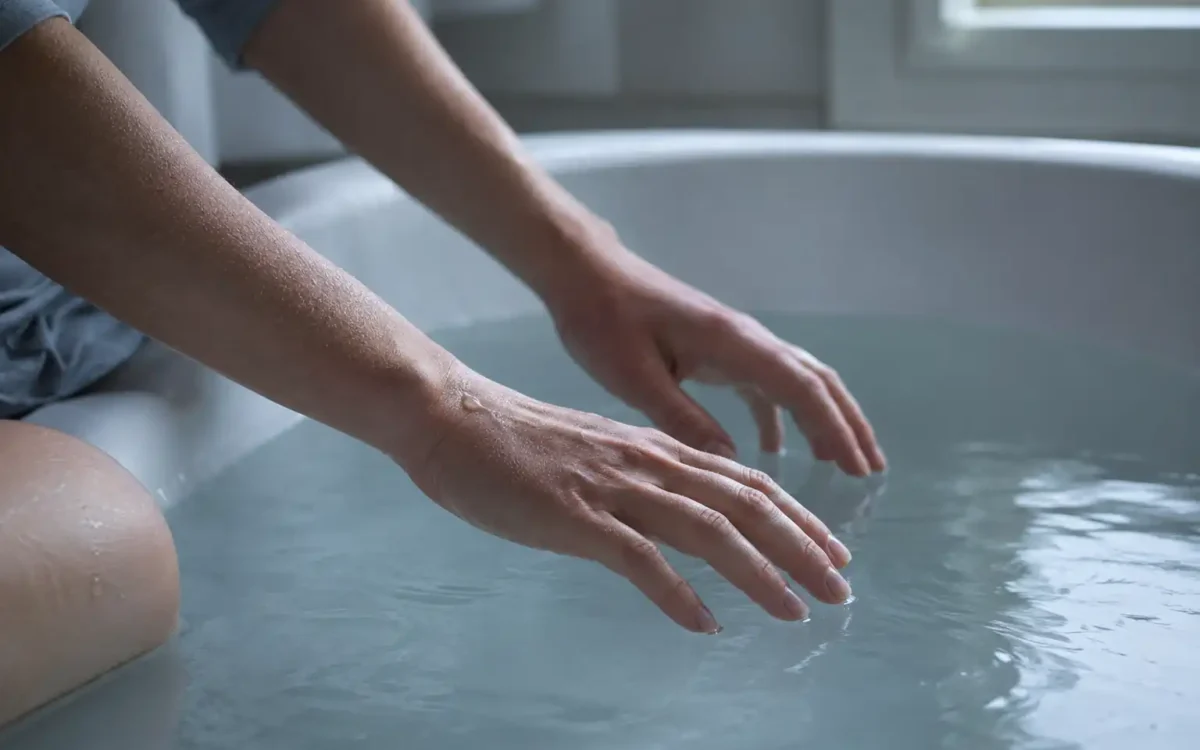
“Cold plunging is good for basically everyone” is one of those claims that sounds true right up until it isn’t — and cold plunge and Raynaud’s disease is one of the clearest exceptions to that rule. For people who deal with Raynaud’s, the same cold exposure other people are chasing for wellness can trigger a genuinely painful, sometimes concerning physical reaction.
This isn’t meant to scare anyone away from asking the question — it’s meant to make sure the answer you get is the right one for your specific situation, not a generic yes borrowed from someone whose body responds to cold completely differently than yours does.
That’s the standard this whole article is written to, so treat what follows as background, not a personal green light.
What Raynaud’s Actually Does to the Body
Simply put, Raynaud’s phenomenon causes the small blood vessels in your fingers and toes to narrow far more aggressively than normal in response to cold or stress. Where most people’s hands just feel chilly, someone with Raynaud’s can lose blood flow to those areas almost entirely for a period of time.
This is exactly why cold plunge raynaud’s syndrome risk isn’t a minor footnote — the entire premise of cold plunging is inducing a strong vasoconstriction response, which is precisely the reaction Raynaud’s already exaggerates on its own.
There are two general categories worth knowing about: primary Raynaud’s, which occurs on its own without an underlying disease, and secondary Raynaud’s, which is linked to autoimmune or connective tissue conditions and tends to be more severe. Knowing which category applies to you is one of the first things a doctor will want to establish before discussing cold exposure at all.
Age of onset and how the condition has progressed also factor into that conversation. Someone whose Raynaud’s has been stable for years carries a different risk picture than someone recently diagnosed whose triggers and severity are still becoming clear.
None of this needs to be memorized in detail before your next doctor’s visit — it’s simply useful context for understanding why a provider will ask more questions than a quick yes-or-no answer would suggest.
Why Cold Plunging Specifically Triggers Attacks
Raynaud’s disease cold water immersion combines two things at once: whole-body cold exposure and submerged extremities, which is close to a worst-case trigger scenario for this condition. Fingers and toes are usually the first and most severely affected areas.
A Raynaud’s attack has a recognizable pattern that’s different from ordinary cold discomfort — it typically moves through distinct color stages as blood flow is cut off and then returns.
Not everyone experiences every stage clearly, and the timeline can range from a few minutes to considerably longer depending on severity and how quickly rewarming happens. What matters most is recognizing the pattern for what it is, rather than dismissing it as an unusually intense reaction to cold.
Raynaud’s fingers turning white cold plunge episodes should never be treated as just an intense version of normal cold sensitivity. This color progression is a specific medical sign, not a subjective discomfort scale.
One detail worth understanding: the attack can continue for a while even after you’re out of the water and toweled off. Rewarming takes time, and the pain that sometimes accompanies the final “red” stage is the tissue reacting to blood flow returning, not a sign that something new has gone wrong.
That said, pain that feels severe, doesn’t ease within a reasonable window, or comes with lasting numbness is different from expected rewarming discomfort and deserves medical attention rather than being written off as normal.
Mild vs. Severe: Does It Change the Answer
Not every case of Raynaud’s carries identical risk, and mild vs severe raynaud’s cold exposure genuinely leads to different practical answers, even though caution applies across the board.
| Raynaud’s Severity | General Guidance |
|---|---|
| Mild, infrequent episodes | May tolerate very brief, moderate cold with caution and medical input |
| Frequent or painful episodes | Cold plunging generally not advised without specialist guidance |
| Secondary Raynaud’s (linked to autoimmune conditions) | Higher caution warranted; underlying condition changes the risk profile |
Some sources describe a theory that gradual, controlled cold exposure could help desensitize an overreactive response over time. It’s worth being direct that this idea is currently speculative and not backed by strong clinical evidence, so it shouldn’t be treated as an established treatment approach.
Other common Raynaud’s triggers are worth keeping in mind too, since they interact with cold exposure rather than existing separately from it. Smoking, certain blood pressure medications, and high emotional stress can all make an attack more likely or more severe, which means the full picture of your risk includes more than just water temperature.
This is part of why two people with technically similar diagnoses can have very different experiences with the exact same cold plunge. A stressful day, a missed medication, or even caffeine intake beforehand can shift how a session actually goes.
If You Still Want to Try, and When to Stop
Is cold plunge safe for raynaud’s ultimately depends on individual clearance, but anyone attempting it — with a doctor’s guidance — is generally advised to start with seconds rather than minutes, use moderate rather than extreme temperatures, and warm up immediately afterward.
Protective steps make a meaningful difference for anyone cleared to try it cautiously. Keeping hands and feet slightly less exposed than the rest of the body, having warm water or dry towels ready before getting in rather than after, and never plunging without someone else present are all small adjustments that reduce risk without requiring any special equipment.
Even something as simple as pre-warming your hands slightly before entering — rather than starting them already cold — can change how quickly and severely an attack develops once you’re in the water.
Raynaud’s often overlaps with broader circulatory and autoimmune conditions, which is worth understanding in its own right — our guide on cold plunge and heart conditions covers some of that overlapping cardiovascular territory in more depth.
This overlap matters practically, not just academically. Someone managing secondary Raynaud’s alongside a connective tissue disorder is dealing with a more complex cardiovascular picture than someone with mild, isolated primary Raynaud’s, and that complexity is exactly the kind of detail a generic article can’t account for on its own.
This is another reason blanket answers tend to fall short here — the same word, “Raynaud’s,” can describe meaningfully different underlying situations depending on what else is going on health-wise.
Stop immediately if you notice:
- Fingers or toes turning white, blue, or gray
- Numbness that doesn’t resolve quickly after exiting
- Sharp or throbbing pain during rewarming
- Any skin changes that concern you, even mild ones
Treating early warning signs as something to push through is a mistake regardless of the condition involved — our broader guide on cold plunge mistakes to avoid covers this pattern in more general terms, and it applies here with even less room for error. General safety fundamentals that apply to everyone are also worth reviewing in our cold plunge safety guide.
It’s also worth deciding in advance, before getting anywhere near cold water, exactly what your stopping point looks like. Deciding mid-session, once discomfort or fear is already setting in, tends to lead to pushing through longer than intended rather than exiting at the first real warning sign.
Writing that plan down, even briefly, and sharing it with whoever is with you removes the guesswork exactly when it matters most.
What I Actually Saw at a Local Cold Plunge Meetup
I once watched someone at a group cold plunge session get out within seconds, visibly alarmed at how quickly her fingers had gone white and lost feeling. She mentioned afterward that she’d been diagnosed with mild Raynaud’s years earlier but hadn’t connected it to how she’d react in a full-body immersion versus just cold weather. It was a clear reminder that a condition someone manages fine day-to-day can behave very differently under a much stronger cold trigger.
What stood out most was how quickly it happened — there was no gradual build-up she could have caught earlier. One moment she was fine, and within what felt like seconds, her hands had already gone white. That speed is part of why erring on the side of caution matters more here than in most other cold-plunge conversations.
Frequently Asked Questions About Raynaud’s
It depends heavily on severity and individual medical guidance. Mild cases may tolerate brief, moderate exposure with a doctor’s input, while more severe or frequent cases are generally advised to avoid it.
Affected fingers or toes typically turn white, then blue, before returning to red with a rush of blood flow — often accompanied by numbness or pain during that final stage.
Some theories suggest gradual desensitization is possible, but this idea is largely speculative and not strongly supported by current research, so it shouldn’t be relied on as a treatment strategy.
There’s no universally safe number, since tolerance varies by individual and severity. This is a question best answered by a healthcare provider familiar with your specific case rather than a general guideline.
Any color change in the fingers or toes — white, blue, or gray — along with numbness or pain during rewarming, should be treated as an immediate signal to stop and warm up.
Have You Actually Checked How Your Body Reacts?
If you’ve never tested a brief, mild cold exposure under safe conditions with medical input, is that a more honest first step than assuming either “it’ll be fine” or “it’s definitely off-limits”? Either conclusion reached without that step is really just a guess.

Related Articles
Cold Plunge When Sick? 6 Rules for Illness, Immunity and a Faster Recovery
Last month I woke up with that unmistakable scratch in the back of my throat — the kind…
Read Guide
Who Should Avoid Cold Plunge? A Complete Safety Checklist
A quick note before you read on: This article shares general safety information, not medical advice. Always talk…
Read Guide
Is Cold Plunge Safe? What the Research Actually Says
A quick note before you read on: This article shares general safety information and isn’t medical advice. Always…
Read Guide