
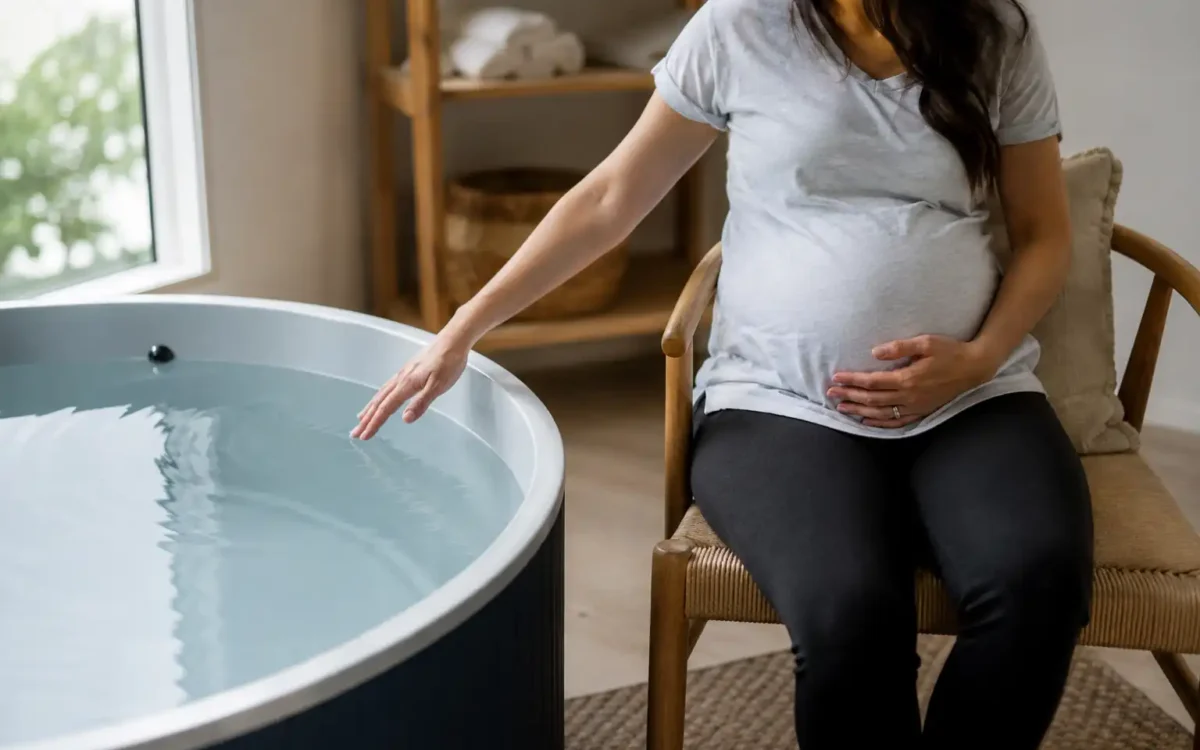
One frequently cited finding on extreme cold exposure and pregnancy found that women exposed to very cold conditions in the first several weeks of pregnancy had a higher likelihood of delivering early. That single data point is a good starting place for understanding cold plunge during pregnancy — not as a scare tactic, but as a reason this decision deserves more care than a typical wellness trend.
Why Pregnancy Changes the Equation
Pregnancy shifts how your body handles temperature and circulation in ways that aren’t obvious from the outside. Blood volume increases substantially, hormonal changes affect vascular tone, and your body’s ability to regulate its own core temperature works differently than it did before.
That’s the backdrop for is cold plunge safe during pregnancy — it’s not that pregnant bodies can’t handle cold at all, it’s that the margin for how your body responds to sudden cold stress has shifted, sometimes in ways that are hard to predict from the outside.
This is also why advice that worked perfectly well before pregnancy doesn’t automatically transfer. A cold plunge routine someone was managing comfortably for months can suddenly carry different implications once pregnancy changes the underlying physiology it was interacting with.
This doesn’t mean every pregnant person needs to treat their body as fragile or off-limits to all forms of activity — most pregnancies tolerate a wide range of normal movement and mild stress just fine. It simply means deliberate, intense cold exposure sits in a different category than everyday activity, and deserves the same individualized scrutiny any new, intense practice would during pregnancy, cold plunging included.
What the Research Actually Points To
Cold plunging while pregnant risks mentioned across available research and clinical guidance generally center on a few specific concerns: restricted blood flow to the placenta from vasoconstriction, a higher chance of hypothermia given pregnancy’s altered temperature regulation, and in some data, a potential link to preterm labor with more extreme or prolonged cold exposure.
It’s worth being direct about the state of the evidence: large, dedicated clinical trials on cold plunging specifically during pregnancy are limited. Much of the caution comes from understanding how the underlying physiology works, combined with a small number of observational findings, rather than a large body of pregnancy-specific cold-plunge research. That’s exactly why individualized medical guidance matters more here than in most wellness topics.
This gap in dedicated research is worth sitting with rather than glossing over. It means confident claims in either direction — “totally fine” or “absolutely dangerous” — are both overstating what’s actually known, which is precisely why generic wellness content can’t responsibly replace a conversation with someone who knows your specific health history.
Ice Bath vs Cold Plunge Tub: Does the Difference Matter Here
Ice bath during pregnancy safety and a temperature-controlled cold plunge tub aren’t automatically the same conversation. An ice bath tends to run colder and less predictably, while a milder, well-regulated cold plunge tub could theoretically pose less thermal shock — though this distinction hasn’t been specifically studied in pregnant populations, so it shouldn’t be treated as a safety guarantee either way.
Cold plunge pregnancy blood pressure concerns apply to both formats, since the vasoconstriction response happens regardless of which container the cold water comes from.
In practical terms, this means the format itself — ice bath, chiller-equipped tub, or even a cold shower — matters less than the underlying question of whether cold exposure of any kind has been discussed with a provider. Treating one format as inherently “safer” without that conversation misses the actual point of the caution.
Who Faces Meaningfully Higher Risk
Risk isn’t uniform across every pregnancy. Certain existing conditions raise the stakes considerably and are consistently flagged across clinical sources as reasons to avoid cold plunging without direct medical guidance.
These aren’t presented as a complete or absolute list — pregnancy health is individual, and a condition not listed here doesn’t automatically mean cold plunging is fine without discussion. The point of this list is to illustrate how varied the relevant risk factors actually are, not to serve as a personal screening tool. If you’re unsure whether something not mentioned here applies to you, that uncertainty itself is worth raising directly with your provider rather than guessing based on a general list.
The overlap with cardiovascular strain is worth understanding on its own terms — the same vasoconstriction and heart-rate response that matters for cold plunge pregnancy high risk conditions is discussed in more depth in our guide on cold plunge and heart conditions, which covers how that response affects circulation more broadly.
It’s also worth noting that risk factors can change during pregnancy itself. Someone who starts out low-risk can develop gestational hypertension or other complications as pregnancy progresses, which is another reason this isn’t a one-time decision made at the start and forgotten — it’s worth revisiting with a provider at different stages.
Warning Signs That Mean Stop Immediately
If cold plunging has already been specifically cleared by a healthcare provider, certain symptoms still warrant stopping right away rather than pushing through them.
Exit the water immediately if you experience:
- Dizziness, lightheadedness, or fainting
- Uncontrollable shivering or numbness
- Any contractions or unusual abdominal tightening
- Shortness of breath or a racing heartbeat that doesn’t settle
Treating warning signs as something to push through rather than respond to is a mistake in any context, but it carries more weight here. Our broader guide on cold plunge mistakes to avoid covers this pattern in more general terms, and the same principle applies with even less room for error during pregnancy.
It’s also worth having a plan before you get in the water, not after something feels wrong. Knowing in advance where you’ll go, who you’ll call, and how you’ll get out quickly removes decision-making from a moment when you might not be thinking clearly. A simple checklist taped near the tub — who to call, how to exit fast, what symptoms mean stop — costs nothing and removes guesswork exactly when it matters most.
| Don’t | Do Instead |
|---|---|
| Start cold plunging without medical clearance | Talk to your provider before your first session |
| Push through dizziness or shivering | Exit immediately if anything feels off |
| Plunge alone | Have someone nearby at all times |
| Assume “mild” is automatically safe | Get individualized guidance regardless of intensity |
Safer Alternatives Worth Discussing With Your Provider
Safe alternatives to cold plunge while pregnant exist for many of the same goals people usually chase with cold exposure — stress relief, reduced swelling, and general relaxation. Gentle movement, prenatal-safe stretching, and lukewarm (never hot) baths are commonly mentioned lower-risk options worth raising with a provider.
None of these are a direct substitute for the specific effects of cold water immersion, but they address a lot of the same underlying goals with a more established safety profile during pregnancy. For general safety principles that still apply regardless of pregnancy status, our cold plunge safety guide covers the baseline precautions everyone should know.
It’s also worth remembering that “waiting” isn’t the same as giving something up permanently. Plenty of people who paused cold plunging during pregnancy picked the habit back up afterward without issue, once their body and their provider both gave the go-ahead. Thinking of it as a temporary pause rather than a permanent loss tends to make the decision feel a lot less like a sacrifice.
A Conversation That Stuck With Me
A close friend of mine was deep into a cold plunging routine before she found out she was pregnant, and her first instinct was to just keep going at a lower intensity. Her doctor’s response surprised her — not an outright “never,” but a lot of specific questions about her blood pressure history and how her early pregnancy was progressing before giving any kind of green light. She ended up pausing entirely for the first trimester, not because someone told her cold plunging was dangerous in general, but because her specific situation called for extra caution that a generic online answer never could have given her.
What she mentioned afterward stuck with me: she’d gone in expecting a simple yes-or-no, and instead got a real conversation about her specific numbers, her specific history, and her specific pregnancy. That’s a level of nuance no article, including this one, can replace.
Frequently Asked Questions
It depends heavily on individual health factors, and medical guidance leans toward caution overall. Anyone considering it should get clearance from their healthcare provider first rather than assuming general wellness advice applies.
Some research has linked extreme cold exposure to an increased risk of preterm birth, particularly earlier in pregnancy, though the evidence specific to deliberate cold plunging is still limited. This is one of the key reasons medical guidance is recommended before trying it.
There’s no universally agreed-upon safe temperature for cold plunging during pregnancy in the current research, which is exactly why this is a question to bring directly to a healthcare provider rather than rely on a general number.
Most available guidance leans toward caution or avoidance, particularly for anyone with high blood pressure, a history of preterm labor, or other pregnancy complications. Individual clearance from a provider is the recommended first step.
Gentle movement, prenatal-safe stretching, and lukewarm baths are commonly discussed lower-risk alternatives, though these should still be reviewed with a healthcare provider based on individual circumstances.
Something Worth Bringing to Your Next Appointment
If cold plunging matters to you, it might be worth writing down your specific questions before your next prenatal visit — the answer that actually applies to you will always be more useful than any general guide, including this one. It’s a five-minute conversation that can save weeks of uncertainty either way, and it’s worth having sooner rather than later.

Related Articles

Cold Plunge When Sick? 6 Rules for Illness, Immunity and a Faster Recovery
Last month I woke up with that unmistakable scratch in the back of my throat — the kind…
Read Guide
Who Should Avoid Cold Plunge? A Complete Safety Checklist
A quick note before you read on: This article shares general safety information, not medical advice. Always talk…
Read Guide
Is Cold Plunge Safe? What the Research Actually Says
A quick note before you read on: This article shares general safety information and isn’t medical advice. Always…
Read Guide